
brought to you by www.energyboom.com
 
“An imperative read for a successful future.”
~LEONARDO DICAPRIO  
 
Clearing the PR Pollution that Clouds Climate Science

Desmog Video

You need Flash player 8+ and JavaScript enabled to view this video.


1956 New York Times Article Warned of Warmer Climate

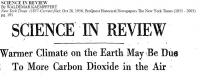
Seems that the idea that human activity is causing climate isn't new at all. The headline in the October 28, 1956 edition of the New York Times warns:

WARMER CLIMATE ON THE EARTH MAY BE DUE TO MORE CARBON DIOXIDE IN THE AIR"

You can download the entire article at the end of this post.

Here are some quotes I've pulled:

Of the three gases that check radiation, carbon dioxide is especially important even though the atmosphere contains only 0.03 per cent of it by volume."

Despite nature's way of maintaining the balance of gases the amount of carbon dioxide in the atmosphere is being artificially increased as we burn coal, oil and wood for industrial purposes."

In a few centuries the amount of carbon dioxide released into the atmosphere will be so large that it will have a profound effect on our climate."

If you enjoyed this story, please consider taking a moment to vote for it on Digg.com by clicking here.


AttachmentSize
warm1956gilbertplassNYT.pdf104.85 KB
What's next?

Comment viewing options

Select your preferred way to display the comments and click "Save settings" to activate your changes.
#296977
FEMACK. +1; Tue, 2008-05-06 13:50; This is very interesting

Before the paranoids at the CEI got a hold of the global warming issue, there was a lot of interesting stuff going on, scientifically. The theory wasn't politicized until the vested interests of oil multi-nationals got involved. As the 20th century wore on, they got more agitated, and by the 1990's, they were getting pretty worried.

It was all pretty straightforward science until American Enterprise got involved.

An for the record, I am NOT now, nor have I ever been, a communist.

Fern Mackenzie

#296978
Paul S. +0; Tue, 2008-05-06 15:45; The theory wasn't
Paul S (not verified)

The theory wasn't politicized until the vested interests of oil multi-nationals got involved. - Fern

Theory is right. However, the "vested" interests are that of the average citizen who is hesitant to see their world turned upside down by warmers with an agenda.

Blaming oil multi-nationals is a tired old strawman when the real opposition to radical measures is your average Canadian.

#296979
Steve L. +0; Tue, 2008-05-06 16:22; Empiricists unite!
Steve L (not verified)

Let's do an experiment. Fern and Paul S would agree this is the best way to settle their argument, right? Fossil fuel multinationals et al can stop investing in politicization of the science and then we can see if public attitudes change. Hey, it seems like the outcome of advocating such an experiment brings us back to the start -- the desmogging of the media.

#296980
Paul S. +0; Tue, 2008-05-06 16:36; Oh please. You're not going
Paul S (not verified)

Oh please. You're not going to bring up the trail of pennies leading back to Exxon, are you Steve?

Citizens have the most powerful tool available to bring about change: the vote. And on the issue of climate change, are choosing not to really use it, opinion polls notwithstanding.

#296982
Steve L. +0; Tue, 2008-05-06 17:32; Familiar refrain
Steve L (not verified)

Read the above comments again (I'm asking everyone) and then decide who was repeating the same position yet again. I wasn't bringing up any trail -- that's your favorite passtime. I brought up something novel. Granted, the never-before-tried experiment gets us back to advocating the same thing that desmog generally advocates. That has something to do with the media ... you know, that thing you don't believe influences votes.
Say, what do you know? The original post is about the media. Interesting.

#296985
Paul S. +0; Tue, 2008-05-06 20:23; What would be novel would be
Paul S (not verified)

What would be novel would be Canadian citizens choosing to live in smaller homes. What would be novel would be Canadians choosing to take fewer airplane trips. What would be novel would be Canadian's actions being consistent with their professed environmental convictions.

The media, governments and oil companies are all smokescreens we use to excuse our own inaction. More educations won't do it, more bashing oil companies won't do it; only large numbers of individual Canadians taking personal responsibility for the issue will do it. [End rant]

#296987
rob. +0; Tue, 2008-05-06 21:55; A Bold Stroke of *SCIENCE*
rob (not verified)

"Let's do an experiment. Fern and Paul S would agree this is the best way to settle their argument, right? Fossil fuel multinationals et al can stop investing in politicization of the science and then we can see if public attitudes change."

Hmm, you seem to have a fascinating hypothesis behind your experiment, Professor L.

You clearly seem to think a causal link exists between "public attitudes" and the average temperature of the Earth.

Brilliant. Yet predictable.

#296988
rob. +0; Tue, 2008-05-06 22:33; The Science Is Settled: Always Listen to the Experts (and NYT)
rob (not verified)

More fabulous predictions!

“A rocket will never be able to leave the Earth’s atmosphere.”
New York Times, 1936.

"Professor Goddard does not know the relation between action and reaction and the need to have something better than a vacuum against which to react. He seems to lack the basic knowledge ladled out daily in high schools."
- 1921 New York Times editorial about Robert Goddard's revolutionary rocket work.

"There will be one million cases of AIDS in Britain by 1991."
- World Health Organisation in a 1989 report. It over-estimated by 992,301 cases.

"Radio has no future."
"X-rays are clearly a hoax."
"The aeroplane is scientifically impossible."
- Royal Society president William Thomson, Lord Kelvin, 1897-9.

"The atom bomb will never go off - and I speak as an expert in explosives."
- U.S. Admiral William Leahy in 1945.

"Television won't matter in your lifetime or mine."
- Radio Times editor Rex Lambert, 1936.

"Everything that can be invented has been invented."
- Charles H. Duell, Commissioner, US Office of Patents, 1899

"Stocks have reached a permanently high plateau."
- Irving Fisher, Professor of Economics, Yale University, 1929

"There is not the slightest indication that nuclear energy will ever be obtainable. It would mean that the atom would have to be shattered at will."
- Albert Einstein, 1932

"With over 50 foreign cars already on sale here, the Japanese auto industry isn't likely to carve out a big slice of the US market."
- Business Week, August 2, 1968

"I think there's a world market for about five computers."
- Thomas J. Watson, chairman of the board of IBM.

"This 'telephone' has too many shortcomings to be seriously considered as a means of communication."
- Western Union memo, 1876

"Louis Pasteur's theory of germs is ridiculous fiction."
- Pierre Pachet, Professor of Physiology at Toulouse, 1872.

"The abdomen, the chest, and the brain will forever be shut from the intrusion of the wise and humane surgeon."
- Sir John Eric Ericksen, British surgeon, appointed Surgeon-Extraordinary to Queen Victoria, 1873.

"Men might as well project a voyage to the Moon as attempt to employ steam navigation against the stormy North Atlantic Ocean."
- Dr. Dionysus Lardner, Professor of Natural Philosophy and Astronomy, University College, London, 1838

#296990
FEMACK. +1; Wed, 2008-05-07 05:35; My! You've been busy!

It's fun reading the old newspapers, isn't it? One thing I must point out, though, about your list of "fabulous predictions" is that all of them are absolute and finite in their pronouncements. None of them allows for any advancement in science, but rather are based on the rather pompous assumption that all that can be known is/was known at the time the pronouncement was made.

On the other hand, Dr Plass was revisiting a theory that had been more or less dismissed when it was raised by Tyndall in 1861. He carried out further study -- work not possible during Tyndall's time due to all kinds of technical limitations -- and published his findings in a scientific journal. The NYT article is a report about that research paper, not a breathless sound bite.

Dr Gilbert Plass re-examines [the theory]in a paper which he publishes in The American Scientist and in which he summarizes conclusions that he reached after a study that he made with the support of the Office of Naval Research. To him, the carbon dioxide theory stands up, though it may take another century of observation and measurement of temperature to confirm it.

In other words, Plass was suggesting that the theory has merit, and ought to be studied over time. His suggestion has stood the test of time, as the predictions on your very amusing list have not, for here we are, with years and years and years of study and evidence heaped up around us to show that Tyndall was right. Only when the implications for profits began to pop up did the issue become political, ie It must be communist if it suggests that the source of our capital might be bad for the planet.

Fern Mackenzie

#296991
DanJ. +0; Wed, 2008-05-07 05:14; logic, please
DanJ (not verified)

As I understand the implied argument of ROB (easily plagiarized from easy-to-find internet sources): if any prediction was ever made that was later proved wrong, then all predictions are wrong.

Or, if some previous hypotheses (or in this case general statement at a meeting or in the popular press) were rejected, than all hypotheses must also be false.

So, by this logic, if science correctly rejects some ideas based on evidence, then all the ones that were not rejected must also be wrong, because they came from science. This is how deniers, of not only climate science but many other unpalatable findings (such as pesticide problems, evolution, ozone, wildlife conservation, etc.), create an all-new 'science' that is not based on evidence, and give themselves the badge of the New Authority.

About the climate cover-up

About the climate cover-up

Democracy is utterly dependent upon an electorate that is accurately informed. In promoting climate change denial (and often denying their responsibility for doing so) industry has done more than endanger the environment. It has undermined democracy.

There is a vast difference between putting forth a point of view, honestly held, and intentionally sowing the seeds of confusion. Free speech does not include the right to deceive. Deception is not a point of view. And the right to disagree does not include a right to intentionally subvert the public awareness.

Although all public relations professionals are bound by a duty to not knowingly mislead the public, some have executed comprehensive campaigns of misinformation on behalf of industry clients on issues ranging from tobacco and asbestos to seat belts.

Lately, these fringe players have turned their efforts to creating confusion about climate change. This PR campaign could not be accomplished without the compliance of media as well as the assent and participation of leaders in government and business.

SUBSCRIBE TO OUR NEWSLETTER

Like what you read here? Get our top five stories in your inbox every week. » here's a preview
Enter your email and subscribe now!


DeSmog Tip Jar

DeSmog Tip Jar

Flickr Photos

Flickr Photos
James Hoggan - Black and WhiteHoggan, Robertson, HarcourtRichard LittlemoreClimate Cover-Up Book Cover

Member of the Progressive Bloggers Network

MEMBER OF THE PROGRESSIVE BLOGGERS NETWORK

Progressive Bloggers