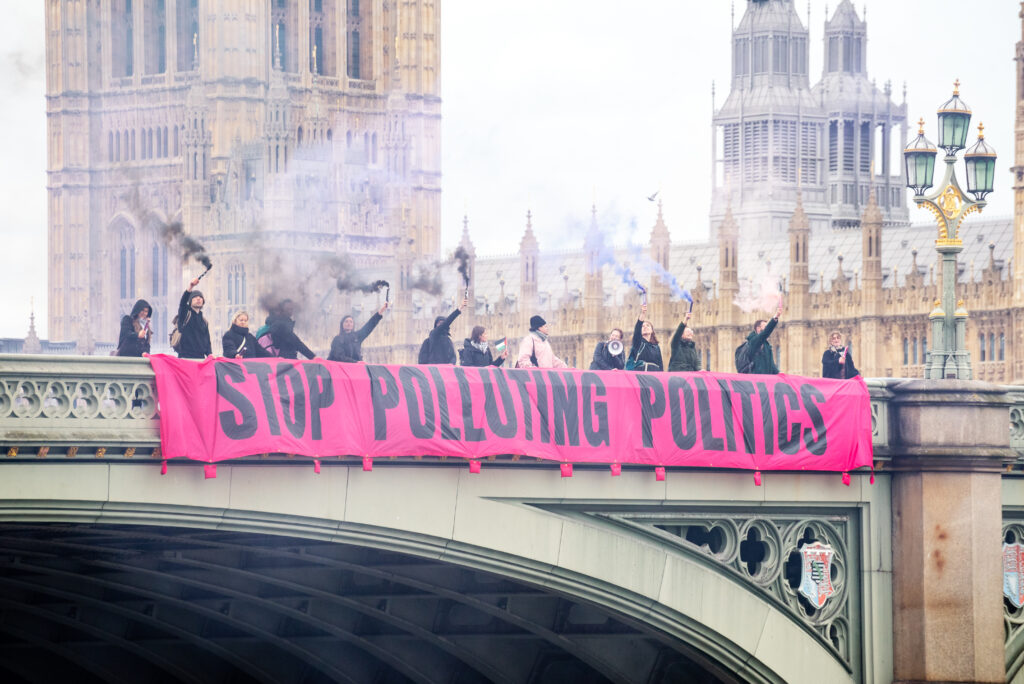
Democracy is utterly dependent upon an electorate that is accurately informed. In promoting climate change denial (and often denying their responsibility for doing so) industry has done more than endanger the environment. It has undermined democracy.
There is a vast difference between putting forth a point of view, honestly held, and intentionally sowing the seeds of confusion. Free speech does not include the right to deceive. Deception is not a point of view. And the right to disagree does not include a right to intentionally subvert the public awareness.
Although all public relations professionals are bound by a duty to not knowingly mislead the public, some have executed comprehensive campaigns of misinformation on behalf of industry clients on issues ranging from tobacco and asbestos to seat belts.
Lately, these fringe players have turned their efforts to creating confusion about climate change. This PR campaign could not be accomplished without the compliance of media as well as the assent and participation of leaders in government and business.
If you, Al Gore or anyone thinks earth is running a fever, you must know what earth's normal temperature is. Please tell us.
How about the relatively stable one we've enjoyed for the past 2000 years?
And that temperature is ... ?
However, since I know that a) you are too lazy to find out for yourself and b) even if you did open a book at the right page you wouldn't understand a word of it (well you might be able to figure out that page 27 comes before page 28) I will give you the information.
The average temperature of the earth is 288 K or approximately 15 degrees C. It can be calculated using a simple formula linking the solar constant (1367 W·m-2), the Earth's average albedo, the Stefan-Boltzmann constant and the earth's emissivity. The emissivity goes down as you increase greenhouse gas concentrations thus causing temperature to rise.
The equation is (1 − a)S = 4εσT4 (note that is T to the fourth power).
So plug in your values and solve for T.
The increase in green house gases has resulted in a rise of approximately 0.7 degrees C over the past 100 years. This is the fever referred to in the post. Both theoretical calculations and actual temperature increase measurements agree pretty well.
Ian Forrester
Excellent post I was going to go and write something myself but extremely well done..I was going to add that changes from the climate optimum over the past 2000 years are about 0.2 - 0.6 depending on the proxy reconstruction (various authors) over significant periods of time (300-400 years), it would seem we've had about 1 degree increase since 1900 or am I interpreting that wrong?
Ian, great post, but I'm afraid it may be a little too much for Rob and John's minds to handle.
You refer to "average" temperature, Ian. To me, that is not the same as normal. An average changes depending on the input data.
Humans have a normal temperature, not an average temperature. Our body temp is regulated by internal mechanisms and under normal circumstances stays at a set level regardless of whether it is hot or cold outside. We say we have a fever when our body temp exceeds 37 C. I asked about earth's normal temperature in that sense.
If someone like Al Gore says earth has a fever, he must have a normal temperature for comparison. Otherwise, how can he know? Gore did not tell us what he meant by that reference and still hasn't, as far as I know.
Googling "earth's normal temperature " is an exercise in frustration. There are more than a million sites and none of the first couple of dozen that I scanned dealt directly with the topic. Is there really any such thing as earth's nomal temp? Can there be when climate always becomes warmer or cooler and is never in stasis?
Must be frustrated to invent your very own "scientific" term and then to find you can't google it.
John you are confusing two parameters, average with normal. When I gave the formula it was for the temperature averaged over the globe’s surface. Thus it only applies when the various parameters in the equation remain constant.
However, we know that these parameters are not constant but vary over time. Thus we can calculate what the global average temperature was in say 1900 or 25,000 YBP by plugging in the values of these variables.
Normal is a much more loosely defined term and means “what we have come to expect”. However, was the lowering of the global temperature after the eruption of Mt. Pinatubo normal? I prefer to say that it was a natural response to changes in the variables in the equation I gave you.
A much better way to describe things is to include natural factors and man-made factors (anthropogenic). Thus if we only include natural variability factors in our equation we get one average temperature. When we also include the anthropogenic factors we get a higher temperature. This increase is the fever referred to.
Between 60 and 70% of the increase in global average temperature over the past 100 years is not natural but is anthropogenic, thus the “fever” is between 0.5 and 0.7 degrees C.
Ian Forrester
Ian, in this context you might be interested in this quote from Jim Hansen in respoonse to a question about Surface Air Temperature (SAT) that appears today (Aug. 27) on junkscience.com.
Q. What exactly do we mean by SAT ?
A. I doubt that there is a general agreement how to answer this question. Even at the same location, the temperature near the ground may be very different from the temperature 5 ft above the ground and different again from 10 ft or 50 ft above the ground. Particularly in the presence of vegetation (say in a rain forest), the temperature above the vegetation may be very different from the temperature below the top of the vegetation. A reasonable suggestion might be to use the average temperature of the first 50 ft of air either above ground or above the top of the vegetation. To measure SAT we have to agree on what it is and, as far as I know, no such standard has been suggested or generally adopted. Even if the 50 ft standard were adopted, I cannot imagine that a weather station would build a 50 ft stack of thermometers to be able to find the true SAT at its location.
... For the global mean, the most trusted models produce a value of roughly 14 Celsius, i.e. 57.2 F, but it may easily be anywhere between 56 and 58 F and regionally, let alone locally, the situation is even worse.
John, what is your obsession with Gore? This isn't Gore's science.
Sadly, tethering the science of climate change back to Al Gore, as if this is "Al Gore's theory of climate change" has been successful in making this a political issue as opposed to a scientific one.
Okay, if this is a "scientific issue" and not a political one, then why is a PR company operating this website?
Kevin, almost everything connected to the global warming scare is about politics. Science does not operate on the basis of scare stories or appeals to consensus. These are, however, common features of poltical campaigns.
If AGW was about science, Gore's movie would be balanced and reflective of the true state of this science. Instead he has produced a piece of propgaganda full of deceptions and fabrications.
If AGW was about science, there would be no Desmog web site devoted to denouncing and demonizing people who, in the spirit of science, question and challenge the AGW hypotehesis.
If it was about science, the IPCC would not be issuing summaries for policymakers that are written by bureaucrats and special interests whose job is to put alarmist spin on the work of the scientific committees.
AGW was never about science. Sadly, it should have been. It is science that will suffer long term damage from allowing itself to be hijacked by environmentalists. When AGW alarmism is shown to be unfounded, as the growing body of research indicates it will be, people will cease to believe anything scientists tell them.
"When AGW alarmism is shown to be unfounded, as the growing body of research indicates it will be, people will cease to believe anything scientists tell them."
An outright lie. There are few, if any, peer-reviewed reports which challenge AGW and thousands which support AGW. The science is settled. AGW is a reality, and the only people who argue against it are ideologically opposed to doing anything about it or are too ignorant to understand the science.
John, you seem not to know what science is. Time to read a climatology textbook.
Stephen, just last week this Desmog website made passing reference to a peer-reviewed study by a guy named Schwartz that challenged the assumption that carbon dioxide is a potent greenhouse gas. There are plenty of others but you are not going to find them here or on alarmist web sites such as Realclimate.
I hope you and your fellow alarmists continue to peddle the line that the science is settled. As it becomes more evident to the public that it is not, your credibility and that of the whole alarmist harlequinade will dwindle to insignificance. Nothing will do you in faster than your own excessive rhetoric. So please keep it coming.
Which Schwartz? There's at least one scientist with that last name, and also at least one denialist. Where's your link John? Did you actually understand what DeSmogBlog said about that paper? Vagueness is not convincing.
And here's an article about how increased CO2 may harm grasslands:
http://www.commondreams.org/archive/2007/08/28/3461/
For next time anyone wants to argue that more CO2 is a good thing.
Do you think I am some sort of walking filing cabinet with reference material constantly at my fignertips? It was last week, the guy's name was Schwartz (Stephen, IRC)and it is about CO2. How many research papers on CO2 do you think were publicized last week with an author of that name?
Yeah, you and your fellow alarmists would probably call him a denier. I guess in your circles, that's what they call scientists -- you know those guys who question and challenge scientific hypotheses and otherwise follow the scientific method.
Yeah, yeah extra CO2 may harm grasslands and it may also make my tomatoes, beans and flowers grow better. It is why greenhouses boost CO2 levels. CO2 = plant food. This is not scary, VJ. Try again.
CO2 can kill, as it did at Lake Nyos:
...On 21 August 1986, the lake emitted a large cloud of CO2 in a limnic eruption, which suffocated up to 1,800 people and 3,500 livestock in nearby villages...
http://en.wikipedia.org/wiki/Lake_Nyos
Then there is coal damp which has killed many miners.
...Coal miners in the days before battery powered lamps used an acetylene flame burning in a reflector lamp on their helmets. They also carried another flame that they would carefully adjust to a mark on a ruler in the lamp. They would check its height occasionally while they worked. If the air was getting "bad", the flame would be under the mark. If the flame would suddenly go out, they knew they had hit a pocket of "coal damp" -- carbon dioxide...
http://www.ohscanada.com/ConfinedSpaces/dangerous_places.asp
Coal damp can explode as it did at Hillcrest, in addition to asphyxiating people.
http://www.crowsnest.bc.ca/hillcrest.html
But VJ, CO2 = Life! Didn't you hear that? (end of sarcasm)
If you are too lazy to look something up, why do you bother arguing? You have no special knowledge of your own to share, John, just negativity.
http://www.realclimate.org/index.php/archives/2007/08/friday-roundup-2/
Why are Schwartz's calculations wrong? The early scientific reviews suggest a couple of reasons: firstly, that modelling the climate as an AR(1) process with a single timescale is an over-simplification; secondly, that a similar analysis in a GCM with a known sensitivity would likely give incorrect results, and finally, that his estimate of the error bars on his calculation are very optimistic. We'll likely have a more thorough analysis of this soon…
We might as well ignore everything you say, given you think RealClimate.org is an "alarmist" website. The fact is that RC is written by climate scientists, all with thorough peer-reviewed publication histories.
Typical ideological BS coming from you, John.
"However, since I know that a) you are too lazy to find out for yourself and b) even if you did open a book at the right page you wouldn't understand a word of it (well you might be able to figure out that page 27 comes before page 28)"
Ah, I see. So I'm lazy and stupid. You certainly seem to be quite the blow-hard. Did you get beaten up in the schoolyard regularly as a child? Do you still get beaten up in schoolyards by children?
"I will give you the information."
Hurray!
"It can be calculated using a simple formula linking the solar constant"
What?! Are you saying the Sun might have something to do with temperature?! Surely this is blasphemy!
"the solar constant (1367 W·m-2)"
Are you referring to cross-sectional area, or surface area?
"the Earth's average albedo"
And what is the Earth's average albedo, exactly?
"the earth's emissivity"
And what is the Earth's emissivity, exactly?
"The emissivity goes down as you increase greenhouse gas concentrations thus causing temperature to rise."
So you are saying that by decreasing emissivity, thermal radiation absorption is increased? Causing a rise in temperature?
Somebody better tell those people who work around blast furnaces in aluminized heat resistant fire suits. According to you, they should actually be flat black.
Welcome to the lazy/stupid club, Ian.
Your silly ranting above just proves to everyone that you are stupid and are too lazy to inform yourself of the facts. You also show a complete lack of understanding on the whole physics of global warming and the green house effect.
Thanks for confirming my earlier statement that you are lazy and also stupid. You are even so stupid that you do not realize when you are showing your stupidity.
Less stupid people, when digging a hole, stop digging when the hole gets too deep. Stupid people, like you, just keep on digging.
Your blast furnace analogy is one of the funniest examples of some one talking about something they haven't the foggiest idea about I have seen in a long time. You have just shown that you do not understand the difference between the terms emissivity and heat absorption.
Ian Forrester
No, Ian, I'm not confusing the terms, but quite obviously you are.
Are you actually under the impression that for a given body exposed to thermal radiation, all other factors remaining the unchanged, a decrease in it's emissivity will result in an increase in it's temperature?
A yes or no will suffice.
Rob said: “No, Ian, I'm not confusing the terms, but quite obviously you are”. You are definitely confused. You are confusing “albedo” of the earth (which is a form of emissivity) with the emissivity of the atmosphere. This later use of “emissivity” is what is referred to in the equation I presented and what I discussed in its relationship to warming. It is the ratio of EM radiation (at a certain wave length) radiating from the earth’s surface to that which leaves the atmosphere. The EM radiation (IR radiation in this case) is absorbed by the green house gases, makes the molecules more energetic thus warming the atmosphere and thus the earth.
Do a bit of reading and you will see where you are going wrong.
Ian Forrester
Ian, it is amusing to watch you twist in the wind. Unfortunately, as you have probably guessed by now, I know what all the terms mean. I am not confused in the slightest.
But let's recap. Are these, or are these not, your words which I am quoting:
Ian wrote:
"The emissivity goes down as you increase greenhouse gas concentrations thus causing temperature to rise."
Not much room for confusion there.
The atmospheric emissivity is the ratio of radiation leaving the earth's atmosphere to that being radiated from the earth's surface. Since this lost radiation (energy) is trapped it causes a rise in temperature. The lower the amount of radiation leaving the earth's atmosphere, the lower the emissivity and the higher the temperature.
Just to confirm put some values into the equation I gave you and find out for yourself.
Keep on digging.
Ian Forrester
Rob, Ian is correct in his statement. If you are aware of what the terms mean, you obviously don't understand the science if you question the validity of his statement.
Stable? In the last 2,000 years there was been a warm period when the Romans ruled, a cool period during the Dark Ages, a Medieval Warm Period and a Little Ice Age. Now it is warm again. That is a strange definition of stable, Kevin. Time to put your Mann hockey stick away.
John said: "In the last 2,000 years there was been a warm period when the Romans ruled, a cool period during the Dark Ages, a Medieval Warm Period and a Little Ice Age."
Two important points to keep in mind when regurgitating these "facts": firstly, even if they are proven to exist they are not global events but limited to NW Europe. Secondly, at most they represent only 0.2 degrees C variability, not even close to the 0.7 to 1.0 degrees C we are seeing now. The difference between the two sets of numbers represents the "fever".
Ian Forrester
Ian, I have come across references to research that shows both the Medieval Warm Period and the Little Ice Age were felt beyond northern Europe. I don't know if both were global but they were certainly more than regional. The Medieval Warm Period was evident in the Norse reports of Vinland (Newfoundland with grape crops) and evidence of the Little Ice Age has been found in the mountains of South America.
Interestingly, the current "global" warming is reportedly far less apparent in the southern hemisphere, which has been getting cooler of late, Al Gore's dramatic footage of the Antarctic Peninsula's calving glaciers notwithstanding.
Makes you wonder if there is really such a thing as global climate or are there just a bunch of regional/hemispheric climates.
Come up with citations and links if you want anyone to believe you.
John, there has never been any evidence of grapes in Newfoundland. There are very sophisticated methods of analyzing seeds, pollen etc. and I have never come across any reference to scientists finding grape seeds in their "digs". Just more exaggeration and myths put out by the AGW deniers.
Read the science reports, not the fiction put out by old Eric.
Ian Forrester
I think he means England.....Yeah fair call there is no evidence at all for grapes ever growing in newfoundland, maybe they confused blue berries with grapes. Anyways the name Vinland seems to have a number of meanings and locations. Wikipedia offers a faily long discussion on the name, its origins, etc interesting read though totally off topic.
http://en.wikipedia.org/wiki/Vinland#Other_usages_of_the_term_Vinland
Eric was the PR guy who named Greenland.:) His son Leif was the one who visted Vinland.
I wonder if we can do a DNA analysis. The PR gene has only been found in plants till now ;-) I bet that son Leif inherited it from his old man.
Ian Forrester
An excellent representation of climate reconstructions.
http://www.globalwarmingart.com/wiki/Image:2000_Year_Temperature_Comparison_png
I think the use of the word "fever" was a rhetorical device to convey a message. Don't take it literally.
In other news, forest fires in Greece killed 15 people in one day:
http://news.bbc.co.uk/2/hi/europe/6962835.stm
Is Europe's heat wave caused by global warming? Scientists can't say for sure it is; but they can't say it isn't either. And such extreme events are expected to happen as a result of global warming.
http://news.bbc.co.uk/2/hi/science/nature/6915309.stm
There is heat in south-eastern Europe but I don't think there is much anywhere else on that continent. Generally, it has been a pretty cool, wet summer in Europe.
But that's just more evidence of global warming, right? Heat, cold, rain, snow, drought, floods -- that the beauty of global warming -- everything fits!
Central Europe, southern Europe; what, they don't count? Less important to you?
http://www.cnn.com/2007/WORLD/europe/07/24/heatwave.europe.reut/index.html
...Scientists blamed the heavy rains in Britain on the jet stream, a fast-moving air current that is more southerly than usual this year, bringing with it stormy weather.
"Extreme events such as we have seen in recent weeks herald the specter of climate change and it would be irresponsible to imagine that they won't become more frequent," Nick Reeves, executive director of The Chartered Institution of Water and Environmental Management, a scientific group, said...
http://www.reliefweb.int/rw/RWB.NSF/db900SID/YSAR-75FRL8?OpenDocument
Of course the US has had heat waves as well:
http://www.bbc.co.uk/weather/world/news/21082007news.shtml
http://www.eurekalert.org/pub_releases/2007-08/agu-ehw080307.php
...The most accurate measures of European daily temperatures ever indicate that the length of heat waves on the continent has doubled and the frequency of extremely hot days has nearly tripled in the past century. The new data shows that many previous assessments of daily summer temperature change underestimated heat wave events in western Europe by approximately 30 percent...
1880 is the baseline year for this claim so it is not surprising that they find heat waves are longer now than then. That's when we were emrging from the Little Ice Age. So, yes, it has gotten warmer since then. Good thing, too. Warm is better than cold.
Heat is killing people. That's not better.
John, would you rather 35 C than 30 C or even 40 C over 35 C? Heck, I'd rather -35 C than 35 C. At least you can put layers on. When it's so hot, you can't take your skin off.