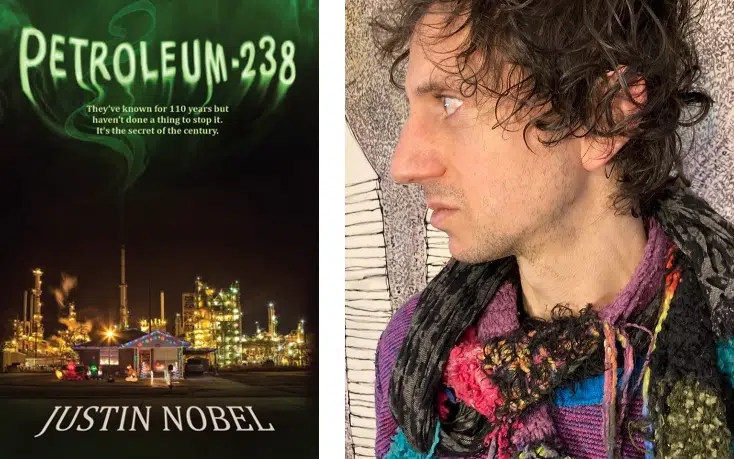
“An exposé of planetary scale.”
~JAMES E. HANSEN  
 
Clearing the PR Pollution that Clouds Climate Science

Desmog Video

You need Flash player 8+ and JavaScript enabled to view this video.


Alberta

Warren Buffett Exposed: The Oracle of Omaha and the Tar Sands

On January 23, Bloomberg News reported Warren Buffett's Burlington Northern Santa Fe Railway (BNSF), owned by his lucrative holding company Berkshire Hathaway, stands to benefit greatly from President Barack Obama’s recent cancellation of the Keystone XL pipeline

If built, TransCanada's Keystone XL (KXL) pipeline would carry tar sands crude, or bitumen (“dilbit”) from Alberta, B.C. down to Port Arthur, Texas, where it would be sold on the global export market

If not built, as revealed recently by DeSmogBlog, the grass is not necessarily greener on the other side, and could include increased levels of ecologically hazardous gas flaring in the Bakken Shale, or else many other pipeline routes moving the prized dilbit to crucial global markets.

Rail is among the most important infrastructure options for ensuring tar sands crude still moves to key global markets, and the industry is pursuing rail actively. But transporting tar sands crude via rail is in many ways a dirtier alternative to the KXL pipeline. “Railroads too present environmental issues. Moving crude on trains produces more global warming gases than a pipeline,” explained Bloomberg.

A key mover and shaker behind the push for more rail shipments is Warren Buffett, known by some as the “Oracle of Omaha” — of "Buffett Tax" fame — and the third richest man in the world, with a net worth of $39 billion. With or without Keystone XL, Warren Buffett stands to profit enormously from multiple aspects of the Alberta Tar Sands project. He also, importantly, maintains close ties with President Barack Obama.


Read more: Warren Buffett Exposed: The Oracle of Omaha and the Tar Sands


Demise of Keystone XL Means More Bakken Shale Gas Flaring

Damned if we do, damned if we don't - this is the CliffsNotes version of the ongoing Keystone XL pipeline debate. President Barack Obama recently halted TransCanada's proposed Keystone XL tar sands pipeline project, which would bring tar sands crude, or dilluted bitumen ("dilbit") from Alberta through the heart of the U.S., to Gulf Coast refineries near Port Arthur, Texas, where the oil would then be exported to the global market.

Most environmental organizations declared victory and suggest the Keystone XL pipeline is dead. Unfortunately, this is far from the case. Republican House Majority Leader John Boehner (R-OH) recently told The Hill he may attempt to rope the pipeline into the next payroll tax extension. Furthermore, a recent Congressional Research Services (CRSpaper said that under a little-used Consitutional clause, the two chambers of Congress, rather than the White House, could have the final say on the pipeline's ultimate destiny. CRS explained, 

[I]f Congress chose to assert its authority in the area of border crossing facilities, this would likely be considered within its Constitutionally enumerated authority to regulate foreign commerce.

Because the pipeline crosses the U.S.-Canada border, many thought that the U.S. State Department, and by extension the White House, had the final say in the manner. This may no longer be true.

On the other hand, even if the Keystone XL becomes a "pipe dream," the grass isn't necessarily greener on the other side.


Read more: Demise of Keystone XL Means More Bakken Shale Gas Flaring


'Consumer Energy Alliance' Front Group Exposed by The Tyee and Salon

In a must-read piece co-published today by Salon.com and The TyeeGeoff Dembicki exposes the dark underbelly of the public relations and lobbying industry, revealing the interconnectedness between Alberta tar sands movers and shakers in Alberta and their oily compatriots in Washington. 

The investigative article focuses on the fossil fuel industry front group Consumer Energy Alliance (CEA), which is run out of the offices of the PR firm HBW Resources, headed by David Holt, Andrew Browning, and Michael Whatley.

Geoff Dembicki's article "Big Oil and Canada thwarted U.S. carbon standards," exposes CEA's effort to thwart government efforts to favor relatively cleaner conventional fuels over the dirtiest forms of extreme unconventional energy like the Alberta tar sands. 

Dembicki reveals how CEA influenced the debate at both the national and state-by-state levels on low carbon fuel standards (LCFS), working to defeat or delay any efforts to differentiate between the emissions footprints of extreme and unconventional fuels like tar sands oil and cleaner-but-still-dirty conventional oil.

Oil industry power players, including BP, Chevron, ExxonMobil, Marathon, Shell and Norway’s Statoil are among the CEA's key financially backers, and many of these companies also happen to have deep ties to the Alberta tar sands.


Read more: 'Consumer Energy Alliance' Front Group Exposed by The Tyee and Salon


Gas Industry Geologists - Not Doctors - Decide If Water Is "Safe" in Alberta Fracking Contamination Cases

Water contamination is at the heart of the fracking debate. Gas companies and their well-funded industry support groups (still) adamantly contend that ‘there are no proven instances of drinking water contamination due to fracking.’ But as Chris Mooney recently wrote about in the Scientific American, and as DeSmogBlog pointed out in our featured report Fracking the Future – this argument is based more on semantics and sly avoidance tactics than scientific evidence, or personal experience for that matter. But in Alberta the oil and gas industry’s ability to deny responsibility for instances of water contamination may be related to an even greater systemic flaw – one which leaves the final verdict in the hands of industry representatives.

In Alberta, landowners who suspect their water is contaminated by gas drilling activity are directed to contact Alberta Environment (AENV), the provincial body that oversees the Water Act, and has just recently been renamed the Ministry of Environment and Water “to emphasize the importance of protecting one of Alberta’s greatest resources.”

AENV responds to complaints in tandem with the province’s oil and gas regulator, the Energy Resources Conservation Board (ERCB), previously the Energy and Utilities Board (EUB).  Upon the event of suspected water contamination, ERCB provides AENV with relevant information about the producing well, including which company it belongs to.  AENV then contacts the company who is directed to “conduct an investigation or hydrogeology study, using a qualified professional.”

Read more: Gas Industry Geologists - Not Doctors - Decide If Water Is "Safe" in Alberta Fracking Contamination Cases


Breaking: State Department Delays Keystone XL Decision Until 2013

The State Department announced today that they would “seek additional information” about the Keystone XL pipeline, meaning that they will take another 12 months at least to re-review the proposed pipeline route. This new review will build on (or make up) for the woefully-incompletely Environmental Impact Statement.

Here's the State Department's official language:


…given the concentration of concerns regarding the environmental sensitivities of the current proposed route through the Sand Hills area of Nebraska, the Department has determined it needs to undertake an in-depth assessment of potential alternative routes in Nebraska. …
Among the relevant issues that would be considered are environmental concerns (including climate change), energy security, economic impacts, and foreign policy.

The decision comes in the immediate wake of a massive protest at the White House on Sunday, as roughly 12,000 anti-pipeline activists circled the White House in a “solidarity hug.” The action was the latest in a series of protests and events staged by opponents of the proposed TransCanada pipeline that would funnel tar sands crude from Canada down to the Gulf Coast in Texas, much of it bound for export to other nations.

The decision to delay is a clear testament to the power of public engagement in the political process and good old-fashioned protest. But the battle isn't over yet.


Read more: Breaking: State Department Delays Keystone XL Decision Until 2013


Canadian Embassy Coaches Diplomats To Promote Tar Sands, Overstate Environmental Protection Efforts

The Canadian government, on the provincial and federal level, needs to tag team on tar sands public relations, according to an internal Canadian Embassy document reported on by Mike De Souza yesterday in the Financial Post. The newly released document, obtained by Environmental Defense Canada through an access to information request, details the outcome of a 2010 overseas trip taken by Alberta’s former Environment Minister Rob Renner. According to the Embassy staff who prepared the report, international investors and stakeholders feel Canada’s lack of unified tar sands advocacy leaves the world’s dirtiest source of energy vulnerable to attack.

During a week long visit to the United Kingdom, Renner heard the concerns of invested parties who suggested Alberta take the lead in a nationwide and government-directed public relations campaign to “temper negative coverage” of the tar sands. 

According to the internal report “there is a strong need for consistent (Alberta and federal government) messaging and cooperation on this file. The opponents of oilsands will find ways to exploit any lack of coherence and coordination, undermining common objectives shared by (the Canadian government) and (the Alberta government) on this issue.”

Read more: Canadian Embassy Coaches Diplomats To Promote Tar Sands, Overstate Environmental Protection Efforts


Syndicate content

FOLLOW US!
 
SUBSCRIBE TO OUR E-NEWSLETTER
Get our Top 5 stories in your inbox weekly.
DESMOG TIP JAR
Help us clear the PR pollution that clouds climate science.

About the climate cover-up

About the climate cover-up

Democracy is utterly dependent upon an electorate that is accurately informed. In promoting climate change denial (and often denying their responsibility for doing so) industry has done more than endanger the environment. It has undermined democracy.

There is a vast difference between putting forth a point of view, honestly held, and intentionally sowing the seeds of confusion. Free speech does not include the right to deceive. Deception is not a point of view. And the right to disagree does not include a right to intentionally subvert the public awareness.

www.know-the-number.com

Our Climate is Changing!
Please download Flash Player.