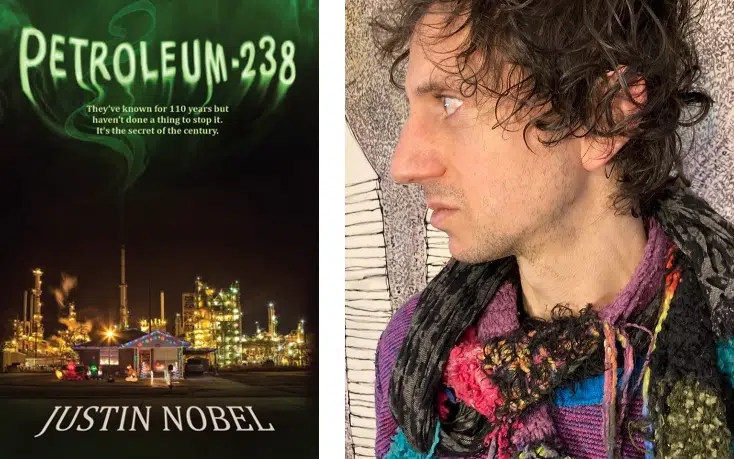
“An exposé of planetary scale.”
~JAMES E. HANSEN  
 
Clearing the PR Pollution that Clouds Climate Science

Desmog Video

You need Flash player 8+ and JavaScript enabled to view this video.


Environmental Protection Agency

EPA Connects Dots Between Groundwater Contamination and Fracking in Wyoming

The tables turned on the gas industry today with the release of a new report by the Environmental Protection Agency (EPA) connecting the dots between fracking and groundwater contamination in the state of Wyoming, located in the hear tof the Niobrara Shale basin.

The report is sure to leave many saying, "Well, duh!" and also asking, "What took them so long?" The perils of fracking for gas in the Niobrara Shale were made famous long ago by Debra Anderson's documenary "Split Estate." 

Report Comes on Heels of Citizen Action in Dimock, PA

The Wyoming report comes on the heels of a large citizen action involving a water delivery to 12 Dimock, Pennsylvania families, led by "Gasland" Director Josh Fox and actor Mark Ruffalo. The action centered around another case of water contaminated by Cabot Oil and Gas. Cabot was delivering clean drinking water since 2008 to the families after it contaminated their water, but recently, the Pennsylvania DEP ordered that Cabot was no longer responsible for transporting water to these families. 

Put another way, cases of water contamination are nothing "new." 

In fact, EPA first tied fracking to contaminated underground sources of drinking water in 1987. In a 25-year old investigative report, discovered by the Environmental Working Group (EWG) and Earthjustice, the EPA outlines how fracking for shale gas contaminated a domestic water well in West Virginia.

More recently, four Duke University scientists released a study in May 2011 linking methane contamination to groundwater on fracking sites.


Read more: EPA Connects Dots Between Groundwater Contamination and Fracking in Wyoming


Opposition to Keystone XL Pipeline Heating Up

The fight against the Keystone XL Pipeline is heating up, with many positive and important developments occuring this past week, excluding the disgraceful, though unsurprising decision by the Obama for President 2012 campaign team to bring a former TransCanada lobbyist, Broderick Johnson (husband of NPR's Michele Norris), onto its upper-level staff.

Six main big ticket items stand out, in particular:

  • call for a U.S. State Department Office of the Inspector General probe into the Keystone XL pipeline review process by 14 U.S. Congressional members.
  • call for a special session to occur on November 1 by Nebraska Republican Governor Dave Heineman regarding pipeline safety concerns.
  • meeting between leaders of the youth climate movement and Environmental Protection Agency (EPA) Administrator Lisa Jackson on the pipeline.
  • A recent massive anti-pipeline action that took place in San Francisco, in which 1,000 protesters greeted Obama at one of his fundraising events for his 2012 presidential run.
  • An announced push-back of the Keystone XL pipeline final decision date by the State Department. 
  • An acknowledgement, at last, by President Barack Obama that he is taking into consideration the concerns voiced by citizens nationwide about the potential risks to public health, water supplies and the global climate if he approves the Keystone XL pipeline.


Read more: Opposition to Keystone XL Pipeline Heating Up


Canada Right On Target, To Miss 2020 Emissions Targets

According to Environment Canada’s peer-reviewed July report on Canada’s Emissions Trends [pdf], government action to date is not putting the country on track to meet the carbon emissions reductions it commited to in 2009.


Read more: Canada Right On Target, To Miss 2020 Emissions Targets


Reducing Air Pollution is Well Worth the Cost

Under the Clean Air Act, the EPA is required to protect states from sulfur dioxide and nitrogen oxide pollution emitted from coal plants in other states. After dragging its feet for a while, the Bush administration introduced the Clean Air Interstate Rule in 2005. Due to its over-reliance on emissions trading, the Clean Air Interstate Rule was shot down (PDF) in December 2008 by the U.S. Court of appeals for the District of Columbia. One year ago today, the Obama administration proposed a plan — the Clean Air Transport Rule — to replace the Bush administration’s flawed Clean Air Interstate Rule.

Finally, today, the EPA finalized an updated version of this rule, now appropriately named the Cross-State Air Pollution Rule (large PDF), which requires power plants in 27 eastern states and the District of Columbia to significantly reduce sulfur dioxide and nitrogen oxide pollution.

The public health benefits of this rule, which goes into effect at the beginning of 2012, promise to be enormous (PDF, p. 12):


Read more: Reducing Air Pollution is Well Worth the Cost


EPA Announces Locations for Fracking Case Studies

The Environmental Protection Agency is currently conducting the largest lifecycle analysis of hydraulic fracturing (fracking) and unconventional gas drilling to date in the U.S. Both advocates and critics of the process are anxiously awaiting the study’s results, which will have an enormous impact on the way lawmakers address the growing concerns over human and environmental health risks associated with the unconventional gas drilling boom.

The EPA last week released the names of seven case study sites for the congressionally mandated study. The overall scope of the investigation is intended to assess the potential impacts of unconventional gas drilling on drinking water supplies.


Read more: EPA Announces Locations for Fracking Case Studies


President Obama’s Fracking Panel Unmoved By Pennsylvanians’ Water Concerns

On Monday, the Natural Gas Subcommittee, from Energy Department Secretary Stephen Chu’s Energy Advisory Board (SEAB), held its second public meeting.  Around 400 people packed a cramped auditorium at Washington Jefferson College in western Pennsylvania to discuss the effects of hydraulic fracturing (a.k.a. fracking) on water supplies, air quality and other threats from the controversial practice.

The crowd split into two camps, those opposing and those supporting the highly contentious drilling method which has spread across Pennsylvania. Fracking opponents argued that fracking is a dangerous and destructive process that must be banned immediately, while those in favour yelled out “drill, baby, drill.”

Given the circumstances it was not surprising that the pro-frackers won the evening. This was due, in large part, to the work of gas industry front-group Energy in Depth who sent out emails to Pennsylvania and New York residents supportive of fracking, offering them airfare, hotels and meals to attend. Tickets to see the Pittsburgh Pirates play the New York Mets were even offered, although later retracted.


Read more: President Obama’s Fracking Panel Unmoved By Pennsylvanians’ Water Concerns


Syndicate content

FOLLOW US!
 
SUBSCRIBE TO OUR E-NEWSLETTER
Get our Top 5 stories in your inbox weekly.
DESMOG TIP JAR
Help us clear the PR pollution that clouds climate science.

About the climate cover-up

About the climate cover-up

Democracy is utterly dependent upon an electorate that is accurately informed. In promoting climate change denial (and often denying their responsibility for doing so) industry has done more than endanger the environment. It has undermined democracy.

There is a vast difference between putting forth a point of view, honestly held, and intentionally sowing the seeds of confusion. Free speech does not include the right to deceive. Deception is not a point of view. And the right to disagree does not include a right to intentionally subvert the public awareness.

www.know-the-number.com

Our Climate is Changing!
Please download Flash Player.