Enbridge

Fri, 2011-07-29 12:14Ben Jervey
Ben Jervey's picture

The Many Problems With Tar Sands Pipelines

Enbridge tar sands pipeline spill Kalamazoo River Michigan

Note: This post is part of an ongoing series about North American pipelines. For an introduction and links to the wide-ranging coverage--from safety to legal issues to the business and economics to vulnerabilities--see this regularly-updated intro post.

On Monday, the House passed a bill that would force the Obama administration to make a final decision on TransCanada's controversial Keystone XL pipeline by November 1. The Keystone XL project (which regular DeSmogBlog readers should be familiar with) would funnel tar sands oil from Alberta's massive reserves down to Gulf Coast refineries in Texas.

This isn't the place to discuss in too much depth the various and plentiful problems with Alberta tar sands itself -- from extraction to transportation to refining to combustion, it's the dirtiest oil on the planet. From a climate perspective, the Alberta tar sands contain enough carbon to lock the planet into climate chaos. In the words of NASA climatologist Jim Hansen, "if the tar sands are thrown into the mix it is essentially game over."

Because Keystone XL is so controversial, and because its construction could be such a tipping point in the climate fight, a broad and diverse coalition of scientists and activists are digging in their heels for a big fight, and planning a multi-week action at the White House. (Here's more on how to get involved.)

But since this is a post about pipelines, I'm going to focus on how tar sands pipelines are different than those that carry conventional crude, how they're much more prone to leaks and spills, and how those spills are particularly bad for the environment.

Thu, 2011-06-02 14:31Emma Pullman
Emma Pullman's picture

Tar Sands Industry Has Its Eyes On Vancouver For Asian Export Terminal

In recent months, opposition to Enbrige's Northern Gateway Pipeline has mounted as citizens, environmental groups and First Nations groups have protested the $5.5 billion dollar pipeline that would bring as many as 220 supertankers per year to Kitimat, B.C., to ship dirty tar sands crude to hungry energy markets in Asia.

While opposition to this project has grown, it's curious that we haven't heard anything about an alternate project to route tar sands crude through Vancouver. 

The recent application to the National Energy Board (NEB) comes from Trans Mountain Pipeline, a subsidiary of Kinder Morgan that operates the 300,000 barrel per day (bpd) pipeline from Alberta to B.C. and Washington State. Their project would vastly expand oil tanker traffic through the waters of Vancouver's Burrard Inlet, and make Vancouver the major conduit of tar sands crude and bitumen to China.

Thu, 2011-05-12 12:37Emma Pullman
Emma Pullman's picture

Spill Baby Spill? The 5,000 Alberta Oil Spills Industry Would Prefer You Did Not Know About

Right now, the oil and gas industry is holding its breath as the approval of two major tar sands pipelines hang in the balance. The $13 billion Keystone XL pipeline would significantly increase the Canadian export of of dirty tar sands bitumen to the U.S. by as much as 510,000 barrels a day. And, on this side of the border, the ferociously debated $5.5 billion, 1,170 kilometre Enbridge Northern Gateway pipeline would carry dirty tar sands bitumen to Kitimat, B.C., where it would be loaded onto supertankers bound for growing energy markets in Asia. 

As the decisions near, a series of major oil spills in the last year have highlighted the dangers these two pipelines pose, particularly given the major expansion of tar sands production they would enable. 

This week, a pump-station equipment failure at a TransCanada pipeline caused 80,000 litres of oil to spill in North Dakota. The Keystone system has suffered 12 leaks since it opened last June, all of them related to equipment failures at pump stations. Despite the frequent spill record, the pipeline is due to resume operations on Saturday

Thu, 2011-03-31 04:45Matthew Carroll
Matthew Carroll's picture

European Union Pushing Back on Canada's Taxpayer Funded Tar Sands Lobbying

Canada Europe flags oiled

Canada does not - as yet - export much tar sands oil to Europe. So why, you might ask, have the Canadian and Alberta governments been working overtime using tax dollars to fund a massive misinformation and lobbying campaign on the other side of the Atlantic?

There's a clue in this press release from January announcing Alberta Energy Minister Ron Liepert's $40,000 lobbying jaunts to the US and Europe: "The European Union is not currently a major market for Alberta’s oil sands products, but any legislation or tariffs adopted by the union’s government can serve as a model for individual nations around the world. We want to continue to share our story with the legislators so they have the facts about our clean energy strategies"

(I'll let the "clean energy strategies" rubbish slide for now.)

It's not about protecting existing markets. At the moment the vast majority of exported tar sands oil goes to the US. For the most part, it's not even about securing a regulatory environment in Europe that protects future potential markets (although that is no doubt a contributing factor). I'll tell you why the Canadian and Albertan governments are so worried that they've been applying pressure on European legislators to a degree at least one EU parliamentarian has declared "unacceptable".

It's about precedent. And they're scared.

Sun, 2011-03-20 12:46Ashley Arden
Ashley Arden's picture

Yes Men Take On Enbridge With Creative Activism

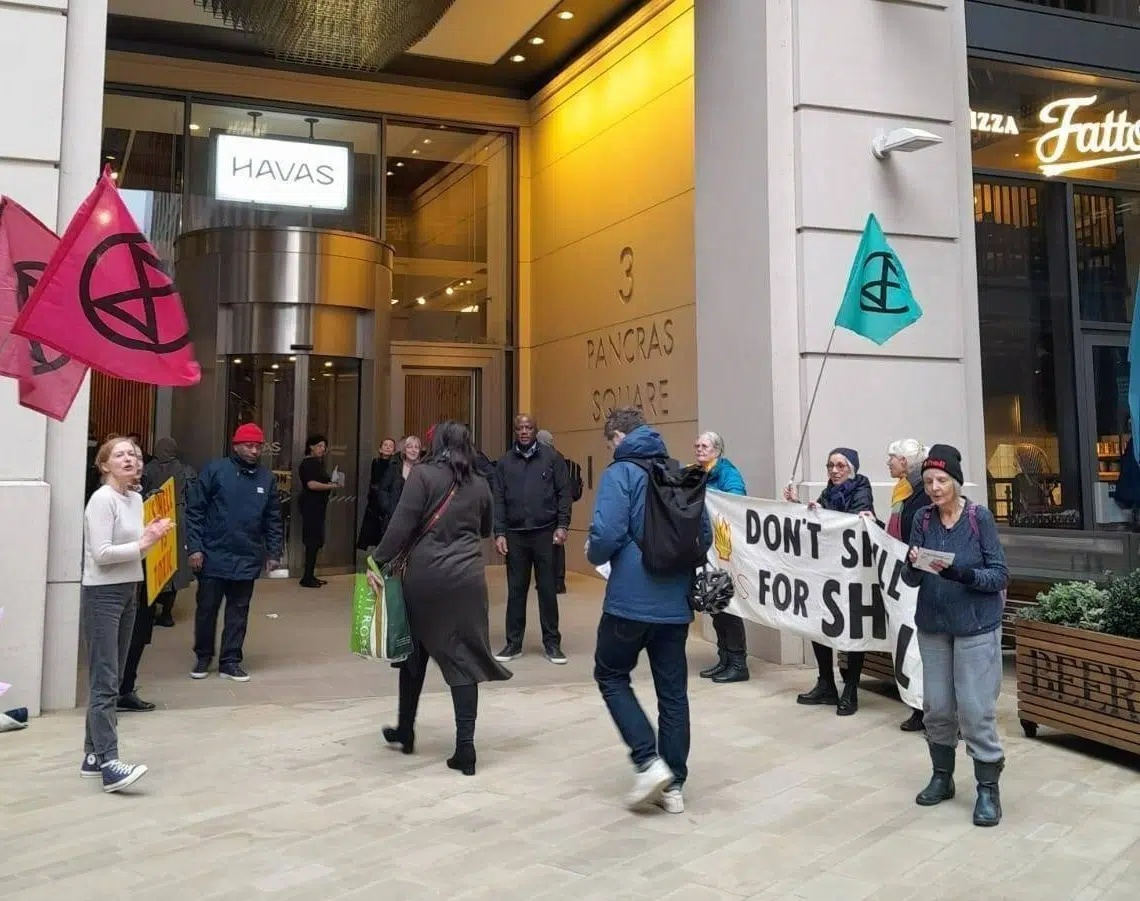
A flurry of cryptic emails last weekend brought out the usual crowd of Vancouver environmental activists to Enbridge’s doorstep, but something is different. There’s no angry chanting, no snide slogans – not a fighting word within earshot. At the height of lunch hour on suit row, protesters are clogging the street and the atmosphere is, well, light. With free haircuts and mock reporters, the community has come out to help set the record straight. The message? An oil spill is inevitable and Enbridge doesn’t have a plan.

The Yes Men–inspired MyHairCares Initiative invited salons across Canada to donate their hair clippings to help Enbridge prepare for future oil spills with “super-absorbent hair booms.” Greenpeace’s Rex Weyler responded by slamming Enbridge for the paucity of the [fake] initiative. The story was initially picked up by major media outlets across Canada, but as the haze of confusion cleared, the stories were pulled from their websites.

Will the real Enbridge please stand up?

Mon, 2011-01-17 13:58Emma Pullman
Emma Pullman's picture

Why We Need to Stop Calling Tar Sands Oil "Ethical Oil"

There are few terms in the Canadian vernacular that irk me more than "ethical oil".  Since Ezra Levant's 2010 book "Ethical Oil" hit the scene, it's become the favourite language for government newspeak, and the media.  Worst of all, its given tar sands proponents and the Conservative Government fodder for their debunked argument that tarsands oil is good for us

Levant's book looks at the ethical cost of our addiction to oil, and argues that Alberta tar sands oil is more ethically responsible than oil imported from despotic regimes in the Sudan, Russia, and Mexico, where human rights issues are of concern. 

Though neither Harper nor our new Minister of Environmental Destruction have read the book, the term was exactly what the Conservatives needed to bolster the much-maligned tar sands.  Prior to the echochamber that ensued after the publication of Levant's book,  tar sands oil was often characterized as "dirty" and "controversial" - much to the ire of the government.

 Levant may well have learned the art of spin early in his career while spending the summer in an internship arranged by the libertarian and clean energy/climate change enemy Charles G. Koch Foundation, or through his work with the Fraser Institute.  Levant himself coined the term "ethical oil" in 2009 after being involved in a panel on tar sands oil.  The spin doctor finished the 90-minute debate having not managed to convince his audience of the merits of the toxic oil.  Without admitting defeat, Levant quickly realized that he was going to have to find a different way to spin the dirty oil apart from economic arguments which just weren't resonating with people. 

Tue, 2010-12-14 12:18Emma Pullman
Emma Pullman's picture

Legislation Introduced To Ban Oil Tanker Traffic On B.C.’s North Coast

Today, Vancouver Quadra Liberal MP and former B.C. Environment Minister Joyce Murray introduced legislation in Canada's House of Commons that would formally ban oil tanker traffic in B.C.’s North Coast.  Bill C-606 comes days after a successful House of Commons motion demonstrated support for a legislated ban on oil tankers.

Though the motion carried, the victory was only bittersweet because the motion passed is not binding, and merely calls on the Tory government to legislate a formal ban.  The Conservative government maintains that a ban is unnecessary since a long-standing, informal moratorium on oil tanker traffic and all offshore oil and gas activity has been in effect since 1972.  Yet last year, the Harper government quietly affirmed that it is not legally bound to maintain a moratorium on oil drilling off the coast of British Columbia.  The government determined that the 1972 ban doesn't technically apply to oil-tanker traffic.  To date, eight Canadian prime ministers have upheld the moratorium, but that could all change.  The B.C. government is currently lobbying the federal Conservative government to revoke the ban.  Opposition parties fear the Tory government will allow the ban to be lifted in order to profit from growing Asian energy markets.

Tue, 2010-12-07 17:26Emma Pullman
Emma Pullman's picture

Canada Votes to Ban Tar Sands Oil Tankers off BC Coast; Enbridge Front Group Exposed

Today, Canada's House of Commons approved a motion calling for a permanent ban on oil tankers off British Columbia's coast.  The passed NDP motion introduced by MP Nathan Cullen urges the government to immediately propose legislation to "ban bulk oil tanker traffic" through the Dixon Entrance, Hecate Strait and Queen Charlotte Sound, off the north coast of B.C.  The bill received Parliamentary support in a tight a vote of 143-138, with all opposition parties supporting it and Conservatives opposed.

British Columbia is now one step closer to having a full legislated ban on supertankers off its north and central coasts. The opposition is sending a clear message to the Conservatives to legislate a formal moratorium. 

Today's ban could seriously impact Enbridge, who has plans to develop a $5.5 billion 1,170-kilometre pipeline to carry dirty tar sands bitumen to Kitimat, B.C., where it would be loaded onto supertankers bound for growing energy markets in Asia.

Thu, 2010-11-25 09:46Emma Pullman
Emma Pullman's picture

Alberta and Canadian Governments Complicit in Killing Climate Policy in EU & U.S. to Support Toxic Tar Sands

The Alberta government's multi-million dollar public relations campaign to spin dirty tar sands production in a positive light has received quite a bit of flack from those who see through efforts to tout the tar sands as green, or as a "national treasure"

They haven't just been investing in $56,000 advertisements and op-ed pieces. The governments of Canada and Alberta are also engaged in something much more insidious: a concerted effort to weaken climate policies in other countries, with the aim of ensuring that no impediments exist to Canada’s filthy tar sands. 

The shocking report released by Climate Action Network Canada shows that the Alberta and Canadian governments have been complicit with industry in efforts to undermine climate legislation in the EU and U.S.  The report highlights three devious efforts by industry and government to oppose or weaken energy policy abroad: California's low-carbon fuel standard, which encourages cleaner fuels and discourages burning dirty fuels; Section 526 of the U.S. Energy Independence and Security Act, which stops departments from buying the dirtiest kinds of fuels and the European Union's Fuel Quality Directive, an effort to lower CO2 emissions and move toward cleaner-burning fuels.

Government and industry are behind "a concerted effort to weaken climate policies outside our borders, with the aim of ensuring that no doors are closed to Canada's highly polluting tar sands," the report's authors write. This is the heart of corporate-government complicity, with the secret oilsands advocacy strategy being led by the Foreign Affairs Department, with officials working in both the U.S. and the European Union.  The report's authors fear that these examples appear to be just the tip of the iceberg.

Mon, 2009-07-27 17:38Kevin Grandia
Kevin Grandia's picture

Youth Climate Activists To Secretary of State Clinton: Say No To Tar Sands

Youth climate activists struck again last week, calling on Secretary of State Hillary Clinton to stop the proposed Alberta Clipper pipeline that would “suck filthy tar sands into the U.S.” from Canada.

Pages

Subscribe to Enbridge