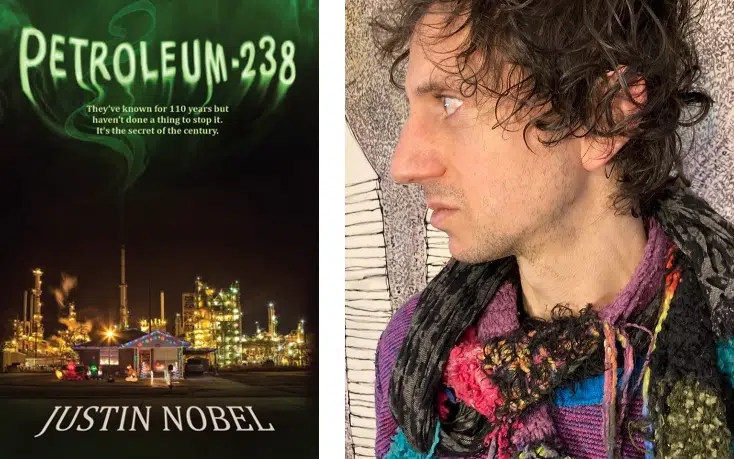
“An exposé of planetary scale.”
~JAMES E. HANSEN  
 
Clearing the PR Pollution that Clouds Climate Science

Desmog Video

You need Flash player 8+ and JavaScript enabled to view this video.


exxon

What We Didn’t Learn From The Deepwater Horizon Disaster

Almost 20 months have passed since the Deepwater Horizon oil rig exploded and spewed millions of gallons of oil into the Gulf of Mexico. And to this day, the lessons we should have learned from that disaster remain completely ignored.

In spite of an intense battle involving a moratorium on deep water oil drilling after the explosion, the Obama administration was out-maneuvered on the issue by the powerful oil industry, losing court battles as well as facing three separate bills in the Republican-controlled House of Representatives to overturn the drilling moratorium. (An interesting side-note about the court battle is that the judge who overturned the ban, Martin Feldman, actually owned stock in Transocean at the time of his decision.)

With oil still washing ashore at the time of the first proposed moratorium, right wing bloggers helped muddy the waters by claiming that the moratorium was devastating Gulf economies. The conservative website Free Republic even posted a video and story about the “Victims of the Obama Drilling Moratorium,” that turned oil companies into the victims as local fishermen and tourist-centered businesses were struggling to make ends meet. Their analysis of the real “victims” was based on “investigations” by oil-funded groups like The Heritage Foundation and the Institute for Energy Research. A commenter on that video had the audacity to claim, “Obama just killed Louisiana more than Katrina.”

But the right wing attacks on the moratorium paid off, and today the deepwater offshore oil industry is once again thriving in the Gulf of Mexico.


Read more: What We Didn’t Learn From The Deepwater Horizon Disaster


The Year In Dirty Energy: Money, Corruption, And Misinformation

It is said that power corrupts, and absolute power corrupts absolutely. That statement has proven itself true time after time in both politics and business, but I would like to amend that statement slightly: Power corrupts, but money and power corrupt absolutely. This year has been no different. We’ve seen unprecedented amounts of money flowing from the dirty energy industry into the hands of politicians in order to achieve everything on their corporate wish lists.

From near constant hammering of the Environmental Protection Agency, to getting approval for dirty energy projects, corporate money has corrupted every level of politics this year.

I already covered the extensive efforts of the Koch brothers in a previous post, but they are hardly the only culprits who are attempting to undermine democracy and decency by pouring money into politics. Here are a few other stories of interest that DeSmogBlog has covered over the last 12 months:

The biggest “non-event” for climate denier dollars this year was the Heartland Institute’s “Denial-a-palooza” conference:


Read more: The Year In Dirty Energy: Money, Corruption, And Misinformation


BP Oil Dispersant Corexit Contained Cancer-Causing Agents

A new report on the Gulf of Mexico oil disaster of 2010 is providing adequate cause for concern for residents and clean up workers along the Gulf Coast. The report from EarthJustice reveals that Corexit, the oil dispersant used by BP to aid in oil cleanup, is laden with cancer-causing chemicals.

The dispersant Corexit was dumped into the oil-stained waters of the Gulf of Mexico to help the oil coagulate and sink to the sea floor. Once the oil clumps reached the bottom, it was believed that they would disintegrate into the water, no longer posing a threat to marine life. But as EarthJustice’s report shows, the threat lingered.

An estimated 1.8 million gallons of Corexit were dumped into the Gulf of Mexico in an attempt to displace the 206 million gallons of oil that spewed from a broken well-head on the Gulf floor. And while the dispersant itself was ruled to be less toxic than the oil, the study suggests that the combination mixture of crude oil and dispersant poses a significantly greater threat to both the environment and marine life than either substance on its own. The EPA says that studies have been done on some of the 57 chemical agents found in dispersants, but they also acknowledge that no long term studies have been conducted on the exposure to these chemicals in quantities as large as were poured into the Gulf.


Read more: BP Oil Dispersant Corexit Contained Cancer-Causing Agents


Meet Marlo Lewis: The Dirty Energy Industry’s Best Friend

When polluters needs someone to write an industry-friendly article, or make an appearance in the media to argue against the science of climate change, they often turn to a man named Marlo Lewis. A senior fellow at the Competitive Enterprise Institute (CEI), Marlo has been on the front lines of the energy industry’s war on science, as well as the fight against the Environmental Protection Agency (EPA), and the battle over the Keystone XL tar sans pipeline.

What makes Marlo a valuable asset is that he actually has a great resume. He received a Ph.D. in government from Harvard – a daunting and admirable task that commands respect. He’s also served in various governmental positions, including a brief stint in the Reagan administration, bolstering his credentials among elected officials in Washington, D.C. His position at the CEI also allows him a great deal of influence over our elected officials (it also happens to pay him a $100,000 a year salary for his work.) These credentials allowed him access to Congress a few years ago, when he was permitted to give a rebuttal to Al Gore’s film “An Inconvenient Truth” to the assembly. Marlo was also allowed to tout the “dangers” of the Kyoto Protocol to Congress in 1998.

But Marlo’s resume does not qualify him as an expert on anything climate or science related. In fact, if you look just below the surface, it becomes starkly apparent that he is just another energy industry crony who is paid to deny that fossil fuel pollution causes problems.


Read more: Meet Marlo Lewis: The Dirty Energy Industry’s Best Friend


Death Of A Talking Point? Regulations Actually Create Jobs

For years, the Republican Party in America has been on a crusade against what they call “job killing regulations.” A quick Google search for the phrase “job killing regulations” returns 368,000 results – many from official Republican Party sources and some others attempting to debunk this talking point.

The phrase “Job killing regulations” has been a consistent battle cry for GOP Congressmembers in their war against workplace safety and environmental protections. True to form, House Majority Leader Eric Cantor (R-VA) echoed this sentiment on Monday with his reference to “job-destroying regulations” in a memo about the Republican plan to further gut the Environmental Protection Agency.

While this talking point is used to berate a lot of different government protections, from checks and balances applied to Wall Street, to product safety laws, to measures safeguarding consumers from dangerous chemicals in food and pharmaceuticals, and so forth.

But most often, the perjorative “job-killing regulations” talking point is used to describe the actions of the Environmental Protection Agency (EPA.) And it has resonated extremely well among an American public that is currently suffering from a severe lack of jobs. As of July 2011, we have an unemployment rate of 9.1%, resulting in almost 14 million Americans looking, but unable to find, a job. For a populace that desperately wants to work but is unable to do so, scapegoating “regulations” has been a very powerful and effective narrative.

Unfortunately for the Republican Party, these “job killing regulations” are a myth. There is no empirical data to back up their claims, but there is a wealth of information available showing that regulations – all regulations – actually promote job growth and put Americans back to work.


Read more: Death Of A Talking Point? Regulations Actually Create Jobs


Koch Brothers And ExxonMobil Join Forces To Fight RGGI With Copy-Paste State Legislation

As we’ve reported over and over again, the popular and successful Regional Greenhouse Gas Initiative (RGGI) and other regional climate agreements are under attack from polluters. Today, a bombshell report by Bloomberg News makes it undeniably clear who is leading the attack, and paints an ugly picture of collusion, influence, and state legislators deep in the pocket of the fossil fuel industry. 

The report shines a light on the American Legislative Exchange Council (ALEC), which serves as a drafting board for industry-friendly state legislation and then subsequently as a sort of mixer for corporations and state politicians who are willing to accept financial favors to bring these copy-and-paste laws back to their home states.

Bloomberg reporter Alison Fitzpatrick 
writes:
The opportunity for corporations to become co-authors of state laws legally through ALEC covers a wide range of issues from energy to taxes to agriculture. The price for participation is an ALEC membership fee of as much as $25,000 — and the few extra thousands to join one of the group’s legislative-writing task forces. Once the “model legislation” is complete, it’s up to ALEC’s legislator members to shepherd it into law.
Fitzpatrick calls out Exxon Mobil and Koch Industries as two companies whose handwriting (forget fingerprints) are all over the template legislation that forces states out of their regional climate agreements.

Read more: Koch Brothers And ExxonMobil Join Forces To Fight RGGI With Copy-Paste State Legislation


Syndicate content

FOLLOW US!
 
SUBSCRIBE TO OUR E-NEWSLETTER
Get our Top 5 stories in your inbox weekly.
DESMOG TIP JAR
Help us clear the PR pollution that clouds climate science.

About the climate cover-up

About the climate cover-up

Democracy is utterly dependent upon an electorate that is accurately informed. In promoting climate change denial (and often denying their responsibility for doing so) industry has done more than endanger the environment. It has undermined democracy.

There is a vast difference between putting forth a point of view, honestly held, and intentionally sowing the seeds of confusion. Free speech does not include the right to deceive. Deception is not a point of view. And the right to disagree does not include a right to intentionally subvert the public awareness.


www.know-the-number.com

Our Climate is Changing!
Please download Flash Player.