“An exposé of planetary scale.”
~JAMES E. HANSEN  
 
Clearing the PR Pollution that Clouds Climate Science

Desmog Video

You need Flash player 8+ and JavaScript enabled to view this video.


Experts Blame BP For Ignoring Warning Signs That Led To Gulf Disaster

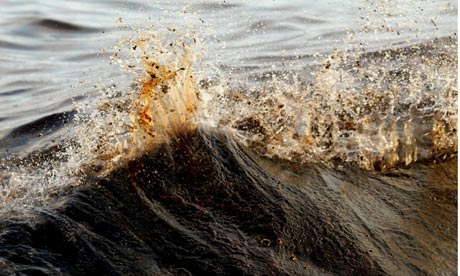
An independent panel of technical experts released its interim report today, finding that BP and its contractors ignored clear warning signs foretelling the disaster at BP’s Macondo well in the Gulf of Mexico.  The report, compiled by a scientific committee of the National Academy of Engineering and National Research Council, criticized BP for an “insufficient consideration of risk” in light of “several indications of potential hazard.”

Convened at the behest of Interior Secretary Ken Salazar, the committee was instructed to carry out an independent and science-based investigation into the root causes of the Deepwater Horizon oil platform explosion which killed 11 workers on April 20, 2010.

The experts note that BP and the other companies failed to learn from “near misses” in the past, and none of the companies or regulators flagged the flawed decisions that contributed to the well blowout.

While the U.S. government continues to allow offshore oil and gas operations following a brief deepwater drilling moratorium, the facts uncovered in independent analyses of the BP blowout point to a systemic industry problem with carelessness and a disregard for safety.  It seems cost-shaving and profit potential are the industry’s key concerns, not the safety of America’s ecologically sensitive coastal environments, and certainly not the safety of workers and affected communities.

AP reports on the study’s findings:

“Among the hazards highlighted in the panel’s report were several tests that indicated the cement at the bottom of the hole would not be an effective barrier to an influx of oil and gas. More than one month before the disaster, BP also lost drilling materials deep in the hole — a situation that hinted to the challenges of the well but was not used to address risks.


And ENS notes that BP cut corners to save money, according to the new report:

“Citing testimony given at the Marine Board of Inquiry hearing into the disaster on July 22 by BP Wells Team Leader John Guide, the committee states, “many of the pivotal choices made for the drilling operation and temporary abandonment of the well were likely to result in less cost and less time relative to other options…”

Reuters has a summary of the report’s findings, including:

“Failures indicate the lack of a suitable approach for anticipating and managing the inherent risks, uncertainties, and dangers associated with deepwater drilling operations.”

The committee will release its final report in June 2011.


FOLLOW US!
 
SUBSCRIBE TO OUR E-NEWSLETTER
Get our Top 5 stories in your inbox weekly.
DESMOG TIP JAR
Help us clear the PR pollution that clouds climate science.

About the climate cover-up

About the climate cover-up

Democracy is utterly dependent upon an electorate that is accurately informed. In promoting climate change denial (and often denying their responsibility for doing so) industry has done more than endanger the environment. It has undermined democracy.

There is a vast difference between putting forth a point of view, honestly held, and intentionally sowing the seeds of confusion. Free speech does not include the right to deceive. Deception is not a point of view. And the right to disagree does not include a right to intentionally subvert the public awareness.


www.know-the-number.com

Our Climate is Changing!
Please download Flash Player.