brought to you by www.energyboom.com
 
“An imperative read for a successful future.”
~LEONARDO DICAPRIO  
 
Clearing the PR Pollution that Clouds Climate Science

Desmog Video

You need Flash player 8+ and JavaScript enabled to view this video.


Government of Canada's Hidden Tar Sand Truths

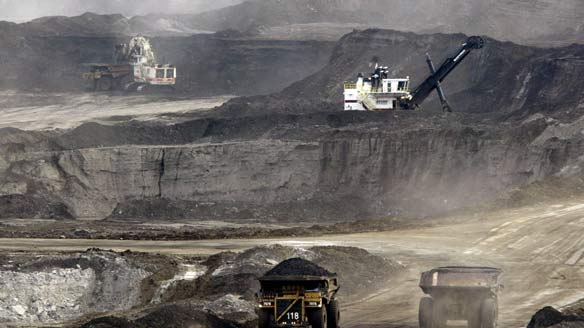
Canwest Newspaper reported late last week that new documents have been uncovered showing a pro-industry bias in Government of Canada studies on the environmental and economic impact of Alberta's tar sands projects.

According to Canwest:

"Officials from Environment Canada who reviewed the original package, warned that it reflected the views of oil companies instead of the facts.

"The package should deliver neutral, balanced and factual information," said the analysis. "Currently, much of the language is too pro-industry, and would make the government to be perceived as bias and thus not credible or serving the public good."

Want the facts on the Alberta Oil Sands? Check our Top 10 Facts About the Alberta Oil Sands section.


What's next?

Comment viewing options

Select your preferred way to display the comments and click "Save settings" to activate your changes.
#712481
paul s. +1; Mon, 2010-01-11 22:33; Some other facts about the

Some other facts about the Alberta tar sands. They provide direct employment to over 100,000 Canadians with indirect employment to another 50,000 Canadians.

Also, the scar on the landscape by mining operations is an area approximately the same size as Edmonton, and much smaller then Toronto or Vancouver.

#712530
paul s. +1; Thu, 2010-01-14 18:10; I should have known that

I should have known that posting the fact that the tar sands provide hundreds of thousands of high paying jobs and pay out billions in transfer payments across the country (and a stable and safe supply of oil to boot) would net me a strongly negative rating.

#712580
Antocalypse. +1; Sun, 2010-01-17 15:04; Well,

Maybe they were voting against your casual justification of the scar on the landscape from mining by its virtue of being smaller than a large city? I know that's why I did. You didn't really need to add it.

Heck, even Wakefield has a positive posting here. He just stuck to one simple assertion on Peak Oil, without his usual lambasting of AGW science.

(But I don't think you really care what anyone here thinks anyway, right?) :-)

#712490
Government of Alberta. +1; Tue, 2010-01-12 11:34; Ten points

Someday, perhaps, desmogblog can update its Top 10 facts, as a great many lean on outdated production forecasts and emissions projections that others have updated themselves, that is, your sources wouldn't likely agree with you, anymore.
If I may, ten points on your ten facts:
1. No, the range starts at half a barrel of water to one barrel of oil. And, 90% of the water used is recycled repeatedly.
2. Yes, and the industry regulator here has issued a directive to the companies to solve the tailings problem. Compliance with the directive is not optional.
3. It would indeed. That is why we monitor the dams so closely.
4. Yes, they did. That is why the operator of that site has been directed to take far better measures to prevent this from occurring.
5. Alberta exports natural gas in the trillions of cubic feet: 1,956.8 billion cubic feet to the U.S. alone in 2008. Yet reducing consumption of natural gas in oil sands production is a goal of both industry and government; it could reduce the costs of production, too.
6. As indicated, we take seriously the problem of tailings ponds and the industry regulator has directed action to address it.
7. Environmental groups want the “carbon footprint” of oil use measured on a full lifecycle. Since only a fraction – one-fifth - of that carbon footprint occurs in production, a barrel of oil sands produces between 5% and 20% of a basket of other crudes. And LESS than some crudes such as California heavy. Furthermore, the world is running out of the light intensity crudes and the carbon footprint of what remains grows. By the way, as of 2010, production is 1.3 million barrels per day.
8. We’re reducing the per-barrel GHG emissions from oil sands production, and have cut more than 30% per barrel over the past 20 years. But yes, as production and consumption rise, emissions rise.
9. The largest single emitter of GHGs in Canada is a coal-fired electricity plant in Ontario. In Alberta, similarly, individual coal-fired plants emit more than any single oil sands operation. Sectorally, coal is a greater emitter, so are personal automobiles. So please, how are you defining “single point source”?
10. Alberta provides roughly 2% of the world’s crude oil needs but the emissions are one-tenth of one per cent of the global GHG emissions. I am, unfortunately, unaware of how much energy - or other critical commodities - Denmark provides to the world.
Thanks!
- David Sands, for the Government of Alberta

#712507
JR Wakefield. +1; Wed, 2010-01-13 19:10; the world is running out of the light intensity crudes

An admission of peak oil from the Government of Alberta.

#712517
Antocalypse. +1; Thu, 2010-01-14 09:29; Updating required where, precisely?

Mr. Sands,
With the exception of point number one, I don't see where you actually disagree with any of the facts presented by desmogblog in their Top 10 list. What is there to update? Whether or not Albertan politicians are concerned about the tar sands?
I am genuinely interested in getting accurate information from sources I trust (it would be hard to trust them otherwise). For example, I have heard recently that the Govt. of Alberta and the tar sands industry have in fact improved the efficiency in their production processes. As a result, it wouldn't surprise me if the low end of the water requirement range dropped from 2.5 barrels to .5, and new information like that would be important for desmogblog to update asap. But with all due respect, I'd want to have a more credible source than a PR blogger for the Alberta government. Can you provide this?
As for the rest of you points, it is somewhat reassuring to hear that the Alberta government is taking the tar sands issues seriously, but well intentioned sentiment doesn't change a single thing in desmog's Top 10 list.
Just saying.

#712544
Government of Alberta. +1; Fri, 2010-01-15 11:06; Why update?

Antocalypse, I understand your skepticism with regard to me, as a PR blogger for the Alberta government. It is my lot in life that were my employer desmogblog instead, you would apparently find me far more credible. So be it.

I suggest an update because it appears from the links that desmogblog extrapolates many of its assertions from a seven-year-old National Energy Board forecast, while Environment Canada releases a national GHG inventory and report every year. The latest was released just last month.

And, just days ago, this from the Conference Board of Canada: http://bit.ly/8IRlt5

- ds

#712579
Antocalypse. +1; Sun, 2010-01-17 14:53; Again

David,
It's true, I am skeptical of the Govt. of Alta. and by extension, its PR people. I think that's fair. You're also probably right in suggesting if you wrote for desmogblog, I wouldn't be as immediately critical of things you might say.
But really, my bias or level of skepticism shouldn't be important. If desmogblog's Top 10 Facts about the tar sands are indeed outdated, inaccurate, and in need up updating, it should be quite easy for you to provide, or point to, the actual data that would corroborate that.
I sincerely respect the fact that the NEB forecast you speak of is seven years old, and that standards and practices in the tar sands have probably improved since that point. But I also would respect desmogblog's need to have an actual updated source for that information before they rewrite their list. Isn't that reasonable?
You're just a guy doing his job, I get that. I'm not even saying that any of your comments are wrong. But if you're critiquing desmog's list, it seems pretty apparent to me that you should have real facts/data that contradicts theirs. Government intentions are not facts.

p.s. The Globe and Mail article you linked says: "Greenhouse emissions from the oil sands have tripled since 1990 to about 40 megatonnes of carbon a year. But Canadian transportation emissions have grown by almost exactly that amount - 38.6 megatonnes." I don't know if this is an improvement by the tar sands or not. I'm open to explanations.

About the climate cover-up

About the climate cover-up

Democracy is utterly dependent upon an electorate that is accurately informed. In promoting climate change denial (and often denying their responsibility for doing so) industry has done more than endanger the environment. It has undermined democracy.

There is a vast difference between putting forth a point of view, honestly held, and intentionally sowing the seeds of confusion. Free speech does not include the right to deceive. Deception is not a point of view. And the right to disagree does not include a right to intentionally subvert the public awareness.

Although all public relations professionals are bound by a duty to not knowingly mislead the public, some have executed comprehensive campaigns of misinformation on behalf of industry clients on issues ranging from tobacco and asbestos to seat belts.

Lately, these fringe players have turned their efforts to creating confusion about climate change. This PR campaign could not be accomplished without the compliance of media as well as the assent and participation of leaders in government and business.

SUBSCRIBE TO OUR NEWSLETTER

Like what you read here? Get our top five stories in your inbox every week. » here's a preview
Enter your email and subscribe now!


DeSmog Tip Jar

DeSmog Tip Jar

Flickr Photos

Flickr Photos
James Hoggan - ColourJames Hoggan - Black and WhiteRichard LittlemoreClimate Cover-Up Book Cover

Member of the Progressive Bloggers Network

MEMBER OF THE PROGRESSIVE BLOGGERS NETWORK

Progressive Bloggers