By Adam Scott for Oil Change International.
The historic announcement by President Obama and Prime Minister Trudeau that both countries would ban oil and gas development in Arctic and Atlantic waters was a major victory to protect our oceans and the people who depend on them, and a real victory for our climate.
But the difference between how the White House and the Prime Minister’s Office explained this announcement reveals a major rift between the leaders in their understanding of how to address the climate threat.
At the end of November, Canadian Prime Minister Justin Trudeau failed a key test of his understanding of what is required to stop climate change by approving the Kinder Morgan and Line 3 pipelines. During his speech he defended his actions:
“I have said many times that there isn’t a country in the world that would find billions of barrels of oil and leave it in the ground while there is a market for it.”
But just weeks later, the U.S. did exactly that. As part of President Obama’s announcement to permanently ban oil and gas development in the Arctic and Atlantic oceans, the White House released a fact sheet explaining its justification.
“…if lease sales were to occur and production take place, it would be at a time when the scientific realities of climate change dictate that the United States and the international community must be transitioning its energy systems away from fossil fuels.”
In essence, the White House is saying that further offshore oil and gas development in these areas fails a climate test — that these projects aren’t in line with the action needed to meet international goals to fight climate change. This is a crucial signal that President Obama and his team are finally beginning to understand that action to restrict the supply of fossil fuels is ultimately required to reach a safe climate future.
Notably, the joint statement from both leaders on their effort to block Arctic drilling mentioned climate but failed to point out this crucial justification for the decision. This points to the fact that Trudeau isn’t aligned with Obama on climate action.
Prime Minister Trudeau continues to cling to an ideological and dangerous assertion that his government has no responsibility to restrict fossil fuel supply in the middle of a global climate crisis.
As Trudeau travels across Canada this week to defend his decision to allow massive new tar sands pipelines, he continues to make wildly contradictory statements. He frequently says that ‘responsible resource development can happen in concert with solid environmental protections’ in the context of allowing new pipelines and tar sands growth to continue. He says this in spite of strong evidence that allowing the pipeline projects would directly compromise both domestic and international climate obligations.
He also continues to argue that his pipeline approvals are baked into his Pan-Canadian climate framework, in spite of the fact that Trudeau’s climate plan is projected to fall short of its 2030 emissions targets, with his government eyeing the purchase of fake international offset credits to make up the gap. This implies that the government knowingly undermined their own efforts when they approved new pipeline projects.
There’s a pipeline shaped hole in Trudeau’s climate plan.
It gets worse. Trudeau continues to put himself on the wrong side of history by aligning himself with President-elect Donald Trump in support of the Keystone XL pipeline, a project which President Obama rejected over its potential to exacerbate climate change and threaten communities along its route.
Trudeau’s view fully ignores the fact that new pipeline projects would lock Canada into rising production of dirty oil and associated climate pollution for decades to come. Because it will be so difficult and disruptive to cut production once those investments have been made, Trudeau’s endorsement of projects that lock-in carbon could put the Paris Agreement goals out of reach — aggravating suffering and harm caused by climate change for millions of people around the world.
It’s time for Trudeau to take a hard look at the legacy his ally President Obama is trying to leave behind. While Obama’s record has been far from perfect, he has in the 11th hour finally begun to demonstrate a clear understanding that success on climate change means keeping fossil fuels in the ground.
Trudeau now has to choose if he wants to join Obama’s legacy as a climate leader or follow Trump’s troubling path towards putting the interests of oil companies ahead of the global community.
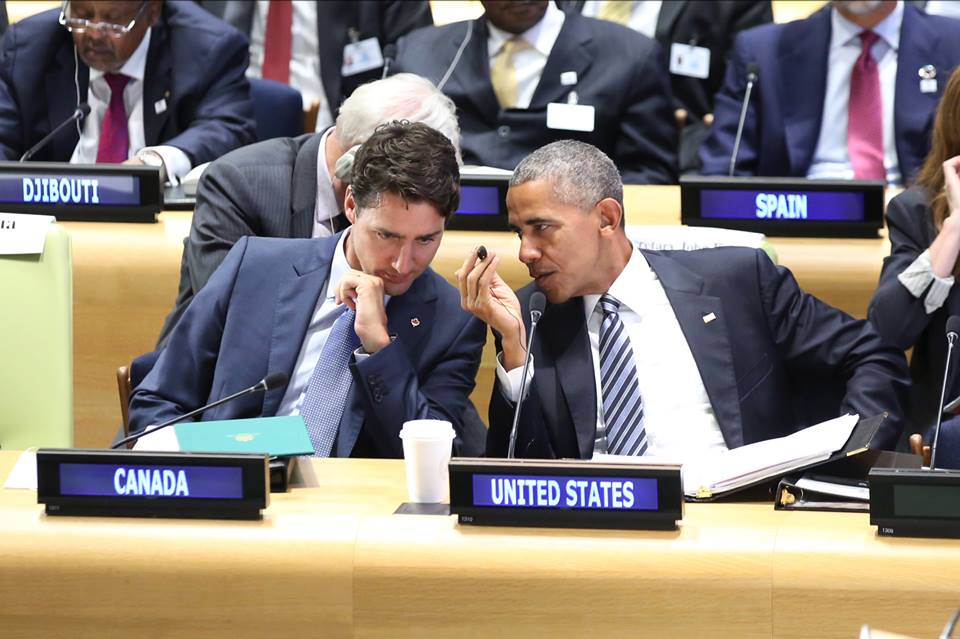
Image: Trudeau and Obama at the UN General Assembly. Photo: Justin Trudeau via Facebook
Subscribe to our newsletter
Stay up to date with DeSmog news and alerts