
Having struggled valiantly over the years to provide a home for any writer or "scientist" who will challenge the global climate change consensus, Canada's National Post has started a series on "The Deniers," people who the Post would laud for trying to undermine Canada's commitment to climate change policy.
First in the series was a "defence" of the esteemed statistician, Dr. Edward Wegman, who appeared earlier this year at a U.S. Senate committee with a critique of the ridiculously controversial "Mann Hockey Stick Graph." Wegman's conclusions in that appearance have been interpreted variously as either a tacit endorsement of Michael Mann's benchmark climate reconstruction or as a devastating criticism. As the DeSmogBlog is not a science site, we recommend that you go to Mann's own RealClimate.org, if you want intelligent interpretation of the statistical bickering.
But there is a public relations element to this fight on which we can comment. The denial industry loves the Mann hockey stick entirely because it is controversial. People like Oklahoma Sentor James Inhofe and National Post business page editor Terence Corcoran obsess about Mann because they can pretend the controversy somehow calls into question all of the science behind the worldwide consensus that human activity is causing climate change.
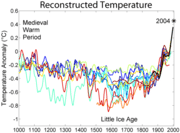
But look at the attached graph (or go see the original at Wikipedia) . It shows 10 different climate reconstructions, all of which lead to the same sorry conclusion as Mann. The short black line, by the way, is the actual temperature since reliable global measurements began.
So, Dr. Wegman is an impressive (if somewhat territorial) statistician .... So, the Mann hockey stick is controversial .... So what?
The consensus remains, and questioning it is not an act of skepticism, it is an act of denial.

More on the NAS report, Wegman and others
There has been a lot of discussion in both the science press and the lay press on the NAS report, the Wegman report and numerous other papers discussing the Mann reconstructions. It is hard for the average reader to put all this information side by side to evaluate it. However, a recent report by Jay Gulledge of the Pew Centre does a pretty good job of putting most of the information in one place. The report can be found at:
http://www.pewclimate.org/what_s_being_done/in_the_congress/7_27_06.cfm
This report shows that the original MBH work was pretty sound, sure any paper you look at after a period of 8 years you would do slightly differently since most scientists don't have the luxury of sitting on a paper for a number of years polishing it and reworking it for ever before submitting for publication. I know that I personally have looked at some of my previous papers and reports and have thought "ooops, why did I emphasize that aspect or not do this differently?" That is how science works in today's environment, do the work you were given the money to do and get it published as quickly as possible.
I would disagree with Wegman's comments that Mann used "wrong methodologies" since statistics is not really part of the experimental protocol. The methodology refers to how samples were taken, how they were analyzed to give the raw data and whether the methods used were approved by others in the field.
Statistics is used to take the raw data (which in most cases will show the trends or points you are trying to make) and show that the results are not based on chance, hence the significance of terms such as 95% confidence, most likely, plausible etc. There is really no hard and fast rule as to what statistical method is best and often it is a personal choice as to which method is used. Obviously, Wegman did not like the choice MBH made but this does not make it wrong since using his choice does not change the curves in any meaningful way.
Another problem some people had with the MBH data was a set of data points he used, saying that they skewed the data to support MBH's point of view. As can be seen in the paper referred to above omitting the "doubtful" data does not change the shape of the curves.
So Wegman's comment “Method Wrong + Answer Correct = Bad Science” is meaningless since the method part of the project was correct and the statistical point was more of a “you didn’t do it my way” response.