National Post Threatens Nazi-like Deprivations

You have to assume that Canada's National Post is guilty of casual disregard for journalistic integrity rather than strategic fear-mongering, but the newspaper made space on its front page today for a vision of Nazi-occupied France - and suggested that's what we're facing if we try to attend to climate change.
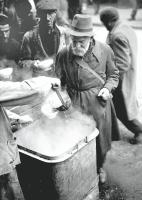
The Post actually printed two photos - a pretty shot of melting ice floes and a dour image of a 1943 French soup-line - under a headline that reads: "TAKE YOUR PICK: ENVIRONMENTAL OR ECONOMIC DISASTER?" An accompanying story begins, "The cost of meeting Canada's Kyoto commitments would be an economic downturn to rival the worst recessions of the past 60 years, spiralling energy costs and the worst unemployment in several generations, John Baird, Minister of the Environment, said yesterday."
Post editors will undoubtedly claim that the Nazi soup-line photo was meant to evoke poverty, but its seems clear that the paper is more interested in selling it's viewpoint than in reporting the news.
Writers at The Post have argued endlessly that climate change and climate science is impossibly complex - that scientists can't understand it well enough to give us reliable information. (See especially The Post's 16-part series, The Deniers.) Rather than present that complexity evenhandedly, however, they break the issue into two emotionally charged images and serve that up as our choice.
If they had done this on the Editorial Page - where people are expecting expressions of raw opinion - or even in the columns of the ever predictable Terence Corcoran, that would be fair game. Presenting it on the front page should come as a reminder to us all: at The Post, every page is the Opinion page. Facts be damned.
- Richard Littlemore's blog
- Log in or register to post comments


Comments
no shame
fear mongers
Then they forget all about how they howled when someone pointed to a frightening possibility at the extreme range of AGW forecasts (Al Gore's rising waters in Manhattan, for example), and tell us our freedoms and economic security will evaporate if we have to pay a bit for polluting the atmosphere. Never mind the huge discrepancy in reversibility in the choices they give us (a carbon tax could be killed, etc), we ought to be too scared to think rationally about the subject.
Fear Mongers
canada could lead the way
Leading by the nose
alarmism
Fox
Conrad Black
There is always another side to the story...
It seems that there is a lot of hot air coming from both sides on the issue of the economic cost of dealing with climate change. Even among academic economists, the Stern report is being debated (rightly so) on its assumptions and methodology, primarily on the question of how much to value the future.
I certainly applaud the goal of this site, but I can't help but notice that the vitrioleometer has been turned up noticely since the site started. If you are sincerely in pursuit of the truth, I suggest an article along these lines.
http://progecon.wordpress.com/2007/04/20/inconvenient-truth/
If the debate is framed on the grounds of meeting Kyoto targets immediately, the conservatives will win hands down. Instead we must implement a plan that balances the needs of the environment and the economy, for economic reasons but also political. Keep in mind that we don't have to only convince the people who frequent this site that the costs of dealing with climate change are worth it, but every other canadian you see walking down the street.
Couple of good points here
The blog does seem to be featuring an increasing amount of vitriol, partly thanks to the snarling criticism from a few intemperate critics and partly, I suspect, out of our own frustration with the endlessness of the disinformation campaign.
It's also true that our passion, unleashed, is not necessarily helpful in closing the gap with all the Canadians who are uninformed rather than ill-informed.
The bottom line, though, is that we're here to applaud action and to raise the flag when other people's pronouncements constitute more spin that substance. It's a necessarily combative task.
Also, regardless of the merits of an argument that holds that Canada CANNOT meet its Kyoto commitments, we are most offended by the people who are arguing that, given the difficult nature of the challenge, we shouldn't try.
Can you please explain why
How dare you doubt?
"But the problem with the environmental movement is they never provide cost benefit analysis for any of their suggestions."
Mike, I think you missspelled, "shrill demands".
.... um, okay
Here's a sampling of articles we have written on the economics of global warming: Here, here, here, here, here, here and here.
And here's a report released in the Summer 2006 by the Canadian government's National Roundtable on the Environment and the Economy. The NRTEE concluded that Canada is in a strategic position to reduce greenhouse gas emissions by over 60% by 2050 using existing technology. They NTREE further concluded that significant reductions "will promote (Canada's) national interest, increasing productivity and competitiveness, improving air quality and meeting the energy needs of our growing economy."
And we wrote about that one here.
As far as the photo, it is taken by Roger Viollet on Dec. 31, 1945 in Halles, France.
Balancing
I take that stark example because we face an even greater threat -- global ecological collapse. You have to be a fool or an ideologue to not see the abundant evidence of it, to not believe what the world's pre-eminent scientists are telling us. Yet you call for half measures! Ask Africans, Asians, and Australians if we can afford to drag our heels into the medium term. They are suffering from death, drought and water-related warfare today.
We should be fully-mobilized to reverse our fossil-fuel folly. Even if we weren't facing the threats of global warming, we still would be threatened by ecological collapse from consuming four times beyond our rightful ecological footprint -- exhausted farmland, felled forests, decimated fish stocks.
Fortunately, many aren't waiting for Harper to pull his head out of the Oil Sands:
http://www.canada.com/vancouversun/news/story.html?id=42bb79c6-ac59-4883-8205-89c67cc88cb0&p=2
These measures aren't killing the economy. They are areas for new investment and employment. So who are the losers going to be? Obviously those who are fighting hard to prevent us from doing anything.
Bang on
It's not denial; it's what's it going to cost?
Costs and how to value them
Yes, Dan did miss the point. The question is about what we have to give up now to pay for a possible event in the future. At a political level, it is extremely unlikely canadians will give up what is necessary to meet Kyoto immediately and in its entirety. (This doesn't mean we can't start, here I agree with Richard). As to what to give up in the medium-long term, economists have to address two very important points.
1) We have to ask how much we value the future. If you answer "I value the future infinitely much, we must do everything possible to stop a potential global collapse" then you are a hypocrite simply by eating breakfast today instead of saving it for tomorrow. If you answer "I don't care about the future, burn everything in site because my house is cold" you are also a hypocrite if you've ever saved a penny. Obviously the answer is somewhere in the middle, and that answer crucially determines how much we are willing to give up. This is a very tough problem to solve and has been worked on very hard by very bright people for the past twenty years or so. I wouldn't bet on it being solved tomorrow.
2) Everyone must realize that science is not perfect, it is a best guess, a probability distribution. Any scientist worth his salt would tell you this. Granted in this case it is a consensus guess, but still these models predict collapse a (larger) percentage of the time. This is a very sticky problem since the outcomes we are most concerned about (global environmental collapse) occur in the outer tails of that probability distribution (they are very very bad). For this reason, it is very difficult to forecast the potential costs. They could be 500 billion or 1 trillion, or 10000000000000000000000. No one knows for sure as this is an event unlike anything we've experienced.
The best source I can find on this is a critique of the Stern Report by Marty Weitzman, an economist at Harvard. I would recommend it as a read for anyone interested, though a background in economics would help. Otherwise you'll have to take my word for it :)
http://isites.harvard.edu/fs/docs/icb.topic135505.files/Weitzman_Paper.pdf
Seems like the link is broken on the paper, I have a copy if someone at the site would like to email me and post it.
You have missed the point of
See...
Weitzman's Critique of Stern Report
If anyone is interested
Link
look again
reply versus new comment
"I wonder how people with your perspective would have applied this approach to World War II, balancing the costs of fighting Fascism as opposed to accommodating it?"
What you are commenting on was the overall subject of the discussion. The reason replies are posted in a tree is because they can be replies to a particular comment, or new comments.
Yes, balancing
Romeo... isn't this whole issue about balance? Balancing the needs of the environment with the needs of humanity... words like sustainability suggest balance to me.
Certainly not the black and white in which some are framing the debate.
The Conservatives are
The Conservatives are unbalanced. If they had any honest intention of trying to improve matters, they would reinstate the energy saving programs that they cancelled and implement more immediately. They would work to slow down oil sands development and require the auto industry to produce only vehicles with reduced emissions; no more trucks escaping the regulations. The only balanced approach starts with taking action now to reduce our use of fossil fuels.
But John Baird, who pretends to be Minister of the Environment, has no balance. He spends his time listening to crybaby corporations instead of scientists. We have a dishonest rightwing government which is not willing to face reality.
natpost
Corruption
And then there's reality ...
"Environmentalists" will have to redouble their efforts to reverse that trend. However, you may encounter some opposition.
Economy a subsidiary of Environment
Think real hard about this 1996 statement by Timothy E. Wirth:
"...Five biological systems -- croplands, forests, grasslands, oceans, and fresh waterways -- support the world economy. Except for fossil fuels and minerals, they supply all the raw materials for industry and provide all our food:
* Croplands supply food, feed, and an endless array of raw materials for industry, such as fiber and vegetable oils.
* Forests are the source of fuel, lumber, paper, and countless other products.
* Grasslands provide meat, milk, leather, and wool.
* Oceans and freshwater produce food for individuals and resources for industry.
Stated in the jargon of the business world, the economy is a wholly-owned subsidiary of the environment. All economic activity is dependent on the environment and its underlying resource base. When the environment is finally forced to file for bankruptcy because its resource base has been polluted, degraded, dissipated, or irretrievably compromised, then the economy goes down to bankruptcy with it..."
Then the human population...
Just to finish the logic for people like Hitler, and the human population declines accordingly.
Then you should be happy
Well, given that you Gaia-botherers are now claiming population growth as a "key driver of climate change", where's the problem?
You should be happy. Population declines, climate magically stops changing and stays at a comfortable room temperature all year 'round, as you imagine it should be. Problem solved.
You've made the options clear. We can either accept your dire, melodramatic predictions and face a new police-state regulatocracy, destroying our economy, and dictating to citizens everything from forced sterilization, to what kind of light bulbs we may use -- OR, possibly "endure" imperceptibly milder winters.
Eenie, meenie, miney, mo ... Hmm, what to do ...?
I'd rather take my chances with the weather, than your loony-tunes predictions, thanks.
Superficial Smokescreen
The majority of people in the developing world would not consider their quality of life decent because it isn't. The statistics only look better when averaging in our extravagant lifestyle, which is four times beyond our rightful ecological footprint and many more times beyond the average inhabitant of the Southern hemisphere.
But let us be generous and accept what you say is true. Given that we've achieved those improvements by voraciously consuming the planet's resources, which is what has happened, what happens when we pass the point of sustainability? Well, we get to where we are now. And the longer we fiddle while Rome burns, the less likely we will avoid the coming collapse.
Apocalypse Whenever ...
Who said they did? It certainly doesn't alter the reality that it is much improved over what it was. Sorry, what was your point again?
"The statistics only look better when averaging in our extravagant lifestyle ..."
No. That is incorrect. Standards of living have improved in the developing world in absolute terms, without reference to the developed world. If you don't believe me, maybe you'll believe the United Nations reports.
I don't know about you, but my lifestyle isn't "extravagant". And it's certainly less extravagant than that of Al Gore or his glamourous Hollywood celebrity groupies.
" ...which is four times beyond our rightful ecological footprint ..."
"Rightful"? Says who? Which kommissar decided what is my "rightful" allotment? Al Gore? Let me know when he gives up his private jet and several luxury mansions, then we can talk.
"... and many more times beyond the average inhabitant of the Southern hemisphere."
Tell you what -- if you're feeling all guilty and conflicted about that, then I invite you to send your
paywelfare cheque to those more deserving."But let us be generous and accept what you say is true."
Your generousity is heartwarming, but unneccessary, since what I say is actually true.
"Given that we've achieved those improvements by voraciously consuming the planet's resources, which is what has happened ... "
Is that what they tought you in your religious catechism? Sorry. I don't worship at that temple.
"... what happens when we pass the point of sustainability?"
I'll worry about that, should it ever happen. The human race is plenty adaptable and creative, so I'm not really panicked about it as you seem to be.
"And the longer we fiddle while Rome burns ..."
And yet, oddly enough, for all your talk of "Rome burning", there doesn't appear to be even whiff of smoke -- other than in your overworked imagination. Which is not to say that various prankster environmentalists don't keep pulling the fire alarm, as they have for decades.
"... the less likely we will avoid the coming collapse."
Ah, yes. The Coming CollapseTM. Ever notice how every religious cult has it's own variation on the End Times narrative? Should The Coming CollapseTM ever come about, I'm sure you and your fellow cult members will be too busy lacing up your brand new Nike sneakers for your journey to the UFO hiding behind the comet, or sipping the Koolaid with the Reverend Jim Jones in the pavillion, to be afffected much by it.
By the way, weren't one of you mumbling something about "alarmists"? Right.
Conservative hypocrisy
As this blog points out:
"...So for the record, the Conservative position on job losses is:
275,000 hypothetical lost jobs = economic armageddon.
250,000 actual lost jobs = stop your bitchin."
Blinkers
By the way, you're sounding extremely shrill. I guess that's what happens when cranks get drowned out by the voice of reason. No one is going to throw you a life preserver.
Uh, yeaaaaaah ...
"Hitler, if you think ad hominem slander gives you any more credibility, you're wrong, quite the opposite."
Hmm, that's odd. That very strategy seems to be working so well for Desmogblog.com.
"By the way, you're sounding extremely shrill. I guess that's what happens when cranks get drowned out by the voice of reason."
LOL!
Bill C-288, the Liberal
Bill C-288, the Liberal sponsored bill, would devastate Canada's living standard to something approaching the Great Depression, WW2, or worse.
Bill C-288, would FORCE us to meet the Kyoto targets by 2012. Job losses in implementing Bill C-288 would result in hundreds of thousands of jobs lost, or more, with rampant homelessness and increased violence.
Bill C-288 is a envirotopian fantasy whose real world effects in Canada would be starkly devestating.
I, and all other sane Canadians will take a pass on Bill C-288.
costs?
Yes, costs
Full Costs, Probability/Risk
Paul G., you failed to explain how meeting our legal commitments under Kyoto would "result in hundreds of thousands of jobs lost, or more, with rampant homelessness and increased violence." John Baird similarly failed.
The Conservative report:
- is premised on a highly inflated carbon tax of $195 per tonne
- ignored cost-saving advantages of new green infrastructure
- ignored job creation from green technology and the aforementioned infrastructure projects
- omits figures used to reach the conclusions
- ignores fiscal policies to reduce Kyoto costs
We're not simply dealing in the probabilities of a hypothetical scenario here. We can look to examples in Europe where numerous countries have gone much further than Canada in reducing their GHG emissions without it resulting in doomsday. Instead, we get a "Little Engine That Can't" government. Pathetic.Probability
Perhaps you didn't see my post above, I urge you to read it.
There are three ways in which probability matter, and to varying degrees.
First, a scientific model, in this case a climate change model, is an abstraction of reality. It is necessarily false. However the degree to which it can be falsified by available data (or simulations) is what determines the model's explanatory power (ie: how good it is). If you can't find data that falsifies it, and other people try to falsify it and fail, then a scientific consensus builds and you can say that your model is a pretty good explanation of reality. No scientist in their right mind (or at least one that understand the scientific method) would ever claim certainty and state "This model is reality" or "sea levels WILL rise six feet." We must factor this point into our decision about policy, there is a chance, perhaps small, that the climate change models are incorrect and that better models can be thought up. In this case I think it's small, but that doesn't mean it doesn't exist. See "The Earth is Flat" (circa 1296) or "Newtonian Physics" (pre-Einstein).
Second, taking the model as given, the statement "Sea levels will rise 6 feet" is an assertion. The statement "In our climate model, sea levels rise an average of 6 feet seven times out of 10" is scientifically valid. We must understand that this is what scientists are telling us. This means that there is a chance, even if the models were true, that we won't see environmental collapse. Again, the chance may be small, although from my reading of the scientific literature it isn't negligible.
Third, and perhaps most importantly, we must determine the shape of the probability distribution over possible outcomes (ie: We have to figure out the chance of a 1 foot sea-level rise, a 2-foot, a 3-foot etc..) and the corresponding costs. This is the most difficult since we are not operating from a position of experience. If i ask you to give me the probability that it will be sunny tomorrow you can give me a pretty good guess. You've seen lots of sunny days before... you know if it's sunny today... etc... But if I ask you to give me the probability that a meteorite hits the earth, that's a far more difficult question. With regard to climate change, we can estimate the cost of a 6 inch rise on sea level relatively well, but estimating the cost of a 6 foot rise is much more difficult. Especially since the the numbers would be so large that even a small error either way means lots of dollars spent or saved today in error.
What does all this mean?
There is no black or white here. Obviously there is a lot of BS coming from people with a stake in the oil industry etc... But that doesn't mean the other side's shit doesn't stink. The Stern Report is valuable for many reasons (ie:awareness), but it has methodological failings as well. To put it bluntly, it made assumptions that tilt the analysis in favor of immediate action. (I'm willing to back this up with sources if anyone has even read this far).
I applaud that this blog is here to fire back, and understand it's necessary, but I don't think we need abandon all principles. People will listen if you reason with them, but they will tune you out if you deny the obvious.
romeogolf, I would suggest
romeogolf, I would suggest you read Bill C-288 first. If that Bill was implemented, it would drive our economy into an immediate depression of devastating proportions.
Bill C-288 is foolish, dangerous and and an environmentalist's Trojan horse that would push hundreds of thousands of Canadians into unemployment and worse.
Legality be damned, meeting our Kyoto targets by 2012 would result in riots on Canadian streets.
I think I detect ...
... a whiff of alarmism here:
"Legality be damned, meeting our Kyoto targets by 2012 would result in riots on Canadian streets.?
Bill C-288, if enacted,
Bill C-288, if enacted, may
Bill C-288, if enacted, may give us short term pain but it would be for long term gain.
However, the Stern Report concluded that a 1% of GDP investment in energy efficient technology and other measures to combat AGW by all nations would prevent a 20% (or greater) shrinkage of the global economy.
Now, what would the 1% be used for? Hmmm. Innovation, manufacturing, etc. What would that do? It would create thousands of jobs in the engineering, research, and manufacturing sectors!
Far from the devastation that the Conservatives were talking about. You wonder whether they even heard of the Stern Report or considered anything beyond the Tar Sands of Fort McMurray.
No Stephen, Bill C-288, if
No Stephen, Bill C-288, if enacted, would annihilate the Canadian economy on a level we haven't seen since the Great Depression. I suggest you read the Bill first before commenting.
Richard's post is intellectually dishonest in that he does not even mention the NP's article was in relation to Bill C-288.
If firm, decisive, and real measures are to be taken in Canada to reduce C02 emissions, Bill C-288 is, with certainty, not the way to do it. Unless riots on the streets of Canada is your goal.
TTF. Typical Tory
TTF. Typical Tory Fearmongering. Complete irrationality and impossible.
Whatever Stephen. I've taken
Whatever Stephen. I've taken you haven't bothered to read Bill C-288. If you had any semblance of rationality to your arguement, you would understand Bill C-288 would be a suicide pact for the Canadian economy.
Sane Canadians will never let our government, Liberal or Conservative, pass this ill thought out, suicidal bill.
Specify the details.
Paul G., you haven't
Paul G., you haven't specified the details which VJ is trying to find out from you. Could it be that you have no explanation for your ideological argument?
Millionaire's Mansions Threatened By Global Warming-We Must Act!
"When the oceans rise 6 feet shorefront property whether in Florida, California, the eastern seaboard, Bahamas, Hawaii, France or Salt Spring Island will be gone. Give or take the most expensive private property world over."
Heh. Given that millionaire John Lefebvre owns mansions in both Malibu and Salt Spring Island, I can see why he's getting all antsy. Oh dear.
"Ask the insurance companies what the value of that will be. I bet there aren't that many zeros in a typewriter."
Look on the bright side -- your yacht will be worth that much more.
" Like they told us in law school, if you know something is on one side or the other, it doesn't really matter exactly where the line is."
Apparently you went to some sort of post-modernist law school?
Pages