
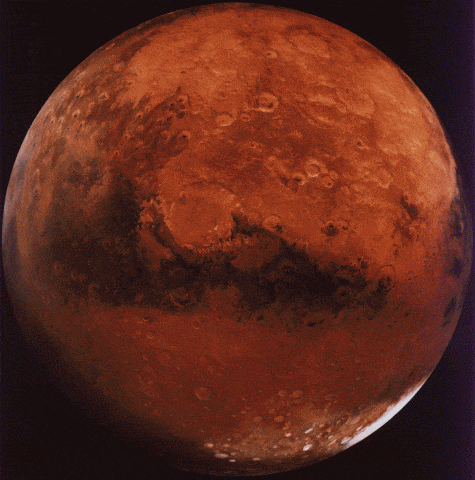
Global warming skepticism knows no (planetary) bounds. The big scientific news of the week was the discovery of methane plumes rising from Mars’ surface. Because methane release on Earth is commonly associated with microbial digestion, NASA researchers believe the greenhouse gas could be a sign of life.
In a new paper published in the journal Science, Michael Mumma, the project’s lead scientist, hypothesizes that bacteria buried one to two miles below the red planet’s surface could be producing the plumes. The other possibility is that the gas is being generated by vulcanism or another geologic process – though that seems less likely since there has been no evidence of active volcanoes. This uncertainty, on top of recent warming trends, has led some to speculate that solar activity may be responsible for Martian climate change.
If, like Earth, Mars has vast stores of buried methane, what else but increased solar irradiance could be driving the observed warming and, thus, methane release?
There are two things wrong with this line of reasoning.
First, the argument presumes that Earth’s and Mars’ climates are similar, which couldn’t be further from the truth. As Steinn Sigurdsson points out, Martian eccentricity is much larger than Earth’s, which makes insolation (incoming solar radiation) variation over the orbit significant and thus results in more pronounced seasonality. Summers and winters on Mars are much longer than ours.
Furthermore, because Mars lacks oceans and has a very thin atmosphere, its climate is much more susceptible to external factors. Mars’ global mean temperature, for example, is highly sensitive to hemispheric dust storms, which, by changing the planet’s atmospheric opacity and convection, can cause wide year on year fluctuations. (When these storms were prevalent during the 1970s, scientists observed a marked period of cooling.)
Second, and perhaps most important, solar irradiance has actually been decreasing slightly over the past few years and, according to Sigurdsson, is now moving towards a minimum. Even disregarding that, climate scientists have long known that variations in solar activity – whether on Earth or other planets – have nothing to do with global warming.
In making that dubious claim, skeptics point to the work of Habibullo Abdussamatov, the director of space research at St. Petersburg’s Pulkovo Astronomical Observatory in Russia, who blamed an increased on solar irradiance for the contraction of the Martian South Polar Cap. He also said that the “considerable heating and cooling on the Earth and on Mars always will be practically parallel.”
That’s a load of hogwash, experts say:
“But Abdussamatov’s critics say the Red Planet’s recent thawing is more likely due to natural variations in the planet’s orbit and tilt. On Earth, these wobbles, known as Milankovitch cycles, are thought to contribute to the onset and disappearance ice ages.
“It’s believed that what drives climate change on Mars are orbital variations,” said Jeffrey Plaut, a project scientist for NASA’s Mars Odyssey mission. “The Earth also goes through orbital variations similar to that of Mars.”’
As I mentioned above, Sigurdsson suggests that hemispheric dust storms could also play a role in influencing Mars’ climate:
“Globally, the mean temperature of the Martian atmosphere is particularly sensitive to the strength and duration of hemispheric dust storms, (see for example here and here). Large scale dust storms change the atmospheric opacity and convection; as always when comparing mean temperatures, the altitude at which the measurement is made matters, but to the extent it is sensible to speak of a mean temperature for Mars, the evidence is for significant cooling from the 1970’s, when Viking made measurements, compared to current temperatures. However, this is essentially due to large scale dust storms that were common back then, compared to a lower level of storminess now. The mean temperature on Mars, averaged over the Martian year can change by many degrees from year to year, depending on how active large scale dust storms are.”
As for Abdussamatov’s claim that solar fluctuations are driving global warming on Earth? “That’s nuts. It doesn’t make physical sense that that’s the case,” says climate physicist Charles Long. Besides, changes in radiation output over a solar cycle are so minute (typically one tenth of a percent) as to not have any impact on recent warming trends.
Any way you spin it, the answer is always the same: Solar activity has nothing to do with global warming. Or, as Michael Mann puts it: “Solar activity continues to be one of the last bastions of contrarians. People who don’t accept the existence of anthropogenic climate change still try to point to solar activity.”
Subscribe to our newsletter
Stay up to date with DeSmog news and alerts